Baidu trains world model on Apollo Go robotaxi fleet data
Source published ·Modelwire updated
Original coverage: AI Business ↗·How Modelwire adds context
The development
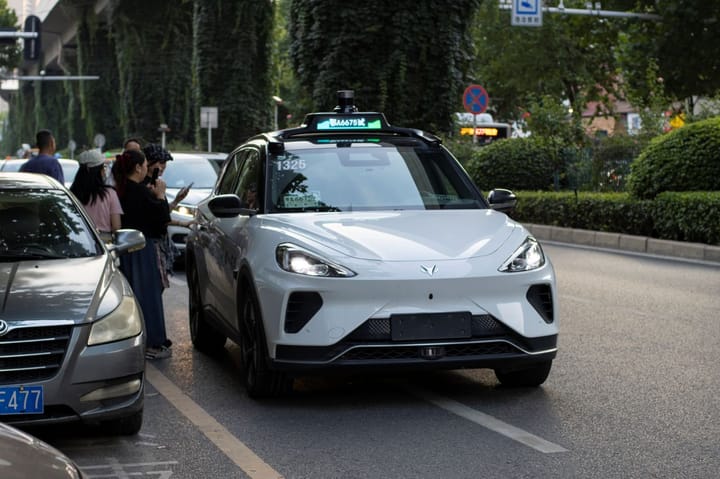
Baidu's latest world model represents a significant shift in how foundation models are trained for embodied AI systems. By leveraging millions of miles of real-world driving data from its Apollo Go robotaxi fleet, the company is demonstrating that physical grounding at scale can unlock capabilities unavailable to purely synthetic or limited-dataset approaches. This move underscores a widening gap between vision-only models and those trained on genuine sensorimotor experience, raising questions about data moats in robotics and whether autonomous vehicle operators now hold structural advantages in building general-purpose embodied AI.
Modelwire’s AI-generated summary of coverage from AI Business.
Modelwire analysis
Analyst takeOur AI-generated reading of the wider context and the next developments to watch.
Baidu isn't just training a better model; it's claiming that operational robotaxi fleets now function as a defensible asset for embodied AI development. The implicit argument is that companies running physical systems at scale can outpace pure research labs or startups, regardless of algorithmic sophistication.
This directly contests the research direction highlighted in recent papers like world2vec and Roz, which emphasize parameter efficiency and mechanistic understanding as paths to better world models. Baidu's approach says data volume and real-world grounding matter more than elegant latent representations. It also echoes OpenAI's pivot toward physical-world applications (their CAD and engineering focus from last week), suggesting that incumbents with operational infrastructure are consolidating advantages in embodied AI, not just software.
If Baidu's Apollo Go model outperforms academic world models on standard robotics benchmarks (e.g., CALVIN, MetaWorld) by Q2 2027 despite using fewer parameters, that validates the data-moat thesis. If instead smaller teams with mechanistic approaches match or exceed its performance, the advantage collapses and the story becomes hype around scale rather than structural superiority.
This interpretation is generated from the summary above and the archive coverage cited below. Our methodology · Report an error
Coverage behind this analysis
These archive entries ground the connection in our analysis. They are ordered by source publication date, with links to our coverage and the original sources.
·arXiv cs.LG
World models fail physics test despite strong task performance
World models trained for robot control often excel at image-matching tasks while failing to capture fundamental physics properties like mass, friction, and deformability. Researchers introduced Roz, a systematic evaluation framework with 13 tasks spanning 1734 scenarios, to expose these gaps in latent representations. The work challenges assumptions about what state-of-the-art dynamics models actually learn, suggesting…
MentionsBaidu · Apollo Go · world model
How this coverage is produced
Modelwire uses AI to generate summaries and context from source headlines, snippets, and selected archive coverage. Automated checks do not verify every claim, and items are not routinely reviewed by a person before publication. Zacaria Solis operates the site. Read the linked source for the full evidence and report errors through our corrections process.
Modelwire summarizes, we don’t republish. AI Business originally reported this story as “Baidu’s new world model highlights value, challenge of physical AI”. The full content lives on aibusiness.com. If you’re a publisher and want a different summarization policy for your work, see our takedown page.