Boston Dynamics deploys Spot robot for mining inspections
Source published ·Modelwire updated
Original coverage: AI Business ↗·How Modelwire adds context
The development
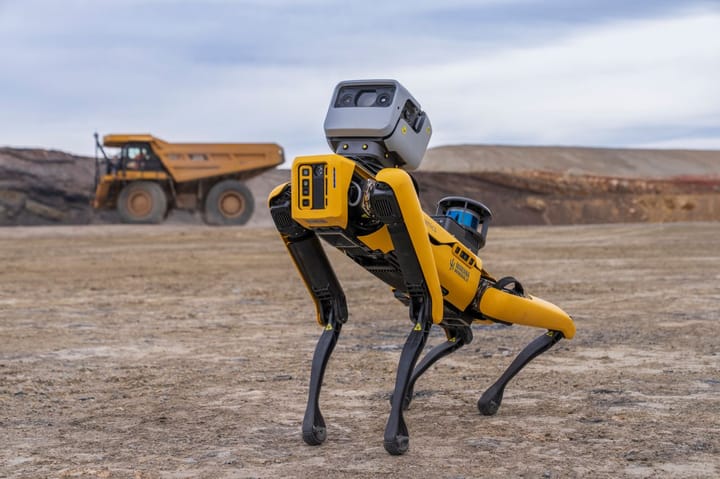
Boston Dynamics' Spot robot is now operating in production at a Utah copper mine, marking a concrete step toward autonomous industrial inspection at scale. The deployment addresses a persistent challenge in mining: hazardous site surveys that expose workers to injury. Spot's role here spans inspection automation, operational optimization, and safety enhancement, suggesting that embodied AI systems are moving beyond research labs into revenue-generating workflows. This validates the commercial thesis that legged robots can handle unstructured, dangerous environments where wheeled or fixed automation fails, potentially reshaping how extractive industries manage risk and labor allocation.
Modelwire’s AI-generated summary of coverage from AI Business.
Modelwire analysis
Analyst takeOur AI-generated reading of the wider context and the next developments to watch.
The deployment is real, but the timing matters more than the milestone itself. Boston Dynamics is moving Spot into revenue operations precisely as Trump administration tariffs threaten to make hardware-dependent AI systems more expensive and fragmented across geographies.
This lands directly in the shadow of the MIT Technology Review piece from August 3rd on robotics protectionism. That story flagged how trade barriers could slow domestic embodied AI deployment and hand advantage to less-regulated markets. The Utah mine deployment suggests Boston Dynamics is racing to prove commercial viability before tariff costs make scaling prohibitive. The timing also contrasts with Alibaba's Qwen positioning from the same week: while Chinese labs reframe automation as consumer liberation, American robotics companies must now justify hardware investments under rising policy friction. For embodied AI, this creates a narrowing window where early deployments either establish enough revenue momentum to absorb tariff costs, or get priced out of the market entirely.
If Boston Dynamics announces three or more new mining or extractive industry deployments in the next 12 months, that signals they're locking in customers before tariff implementation raises costs. If instead deployment announcements slow or shift to lower-risk verticals (warehousing, inspection), that confirms protectionism is already reshaping their go-to-market strategy away from hazardous-environment specialization.
This interpretation is generated from the summary above and the archive coverage cited below. Our methodology · Report an error
Coverage behind this analysis
These archive entries ground the connection in our analysis. They are ordered by source publication date, with links to our coverage and the original sources.
·MIT Technology Review - AI
Trump tariffs target humanoid robotics hardware supply chains
The U.S. robotics sector faces new trade barriers as Trump administration protectionism extends into hardware-dependent AI applications. Humanoid robotics, still in early commercialization despite recent advances in dexterity and mobility, now confronts tariffs and export controls that could reshape supply chains and slow domestic deployment. This marks a critical inflection point for embodied AI: policy…
MentionsBoston Dynamics · Spot · Utah copper mine
How this coverage is produced
Modelwire uses AI to generate summaries and context from source headlines, snippets, and selected archive coverage. Automated checks do not verify every claim, and items are not routinely reviewed by a person before publication. Zacaria Solis operates the site. Read the linked source for the full evidence and report errors through our corrections process.
Modelwire summarizes, we don’t republish. AI Business originally reported this story as “Spot Robot From Boston Dynamics Deployed at Utah Copper Mine”. The full content lives on aibusiness.com. If you’re a publisher and want a different summarization policy for your work, see our takedown page.