Frontier LLMs navigate vehicle control without driving-specific training
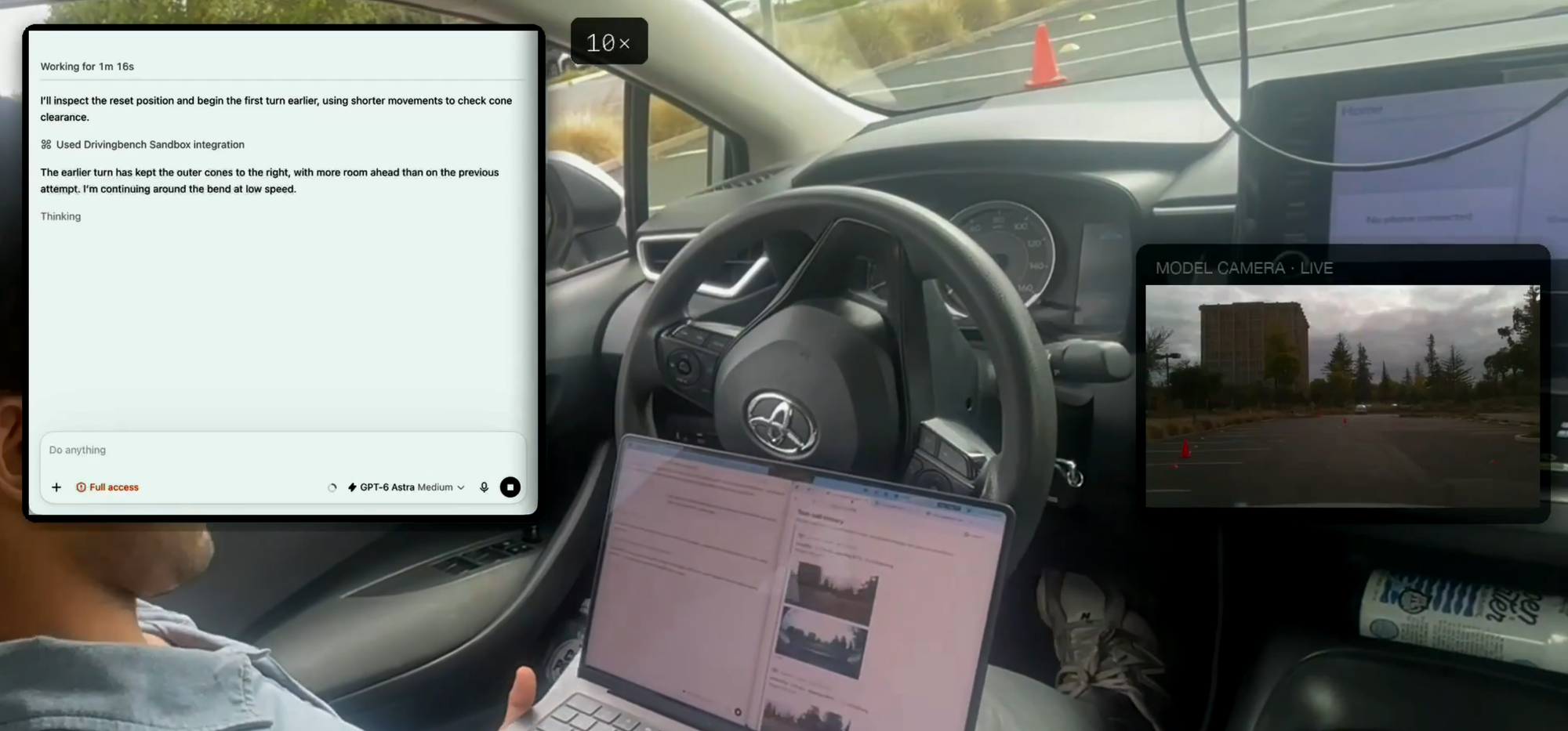
Researchers successfully deployed frontier large language models to control a vehicle in real-world conditions without any prior driving-specific training data. The experiment demonstrates that contemporary LLMs can translate natural language reasoning into physical control tasks, marking a meaningful step toward embodied AI systems. This bridges a critical gap between language understanding and robotics, suggesting frontier models may serve as general-purpose reasoning engines for autonomous systems. The result carries implications for how AI labs approach multimodal reasoning and whether language-first architectures can substitute for task-specific training in safety-critical domains.
Modelwire context
Skeptical readThe claim hinges on 'no prior driving-specific training data,' but the summary never clarifies what other data or scaffolding the model received. Was this tested on open roads or a closed course? How many attempts? The absence of these details suggests the headline may be doing more work than the actual capability.
This connects directly to Hugging Face's recent work on source-aware verification for MCP agents. Both stories grapple with the same underlying problem: as LLMs mediate between reasoning and real-world action (whether through APIs or now vehicle control), the field is discovering that capability alone is insufficient. The Hugging Face piece flags hallucination and attribution failures at the agent layer; this driving experiment raises the same question at higher stakes. Neither story yet addresses how to audit or verify the reasoning chain when failures have physical consequences.
If the researchers release video of the same model handling an unscripted route with genuine traffic and pedestrians (not a test track), and if that video shows graceful failure modes rather than dangerous hallucinations, the claim holds weight. If the follow-up paper reveals the model was fine-tuned on simulation data or required extensive prompt engineering, the 'no driving-specific training' framing collapses.
Coverage we drew on
This analysis is generated by Modelwire’s editorial layer from our archive and the summary above. It is not a substitute for the original reporting. How we write it.
MentionsChatGPT · Toyota Corolla · 404 Media
Modelwire Editorial
This synthesis and analysis was prepared by the Modelwire editorial team. We use advanced language models to read, ground, and connect the day’s most significant AI developments, providing original strategic context that helps practitioners and leaders stay ahead of the frontier.
Modelwire summarizes, we don’t republish. 404 Media originally reported this story as “These Tech Workers Made ChatGPT Drive a Toyota Corolla”. The full content lives on 404media.co. If you’re a publisher and want a different summarization policy for your work, see our takedown page.