ICE’s Plan to Let Cops Around the Country Scan Faces to Verify Immigration Status
Source published ·Modelwire updated
Original coverage: 404 Media ↗·How Modelwire adds context
The development
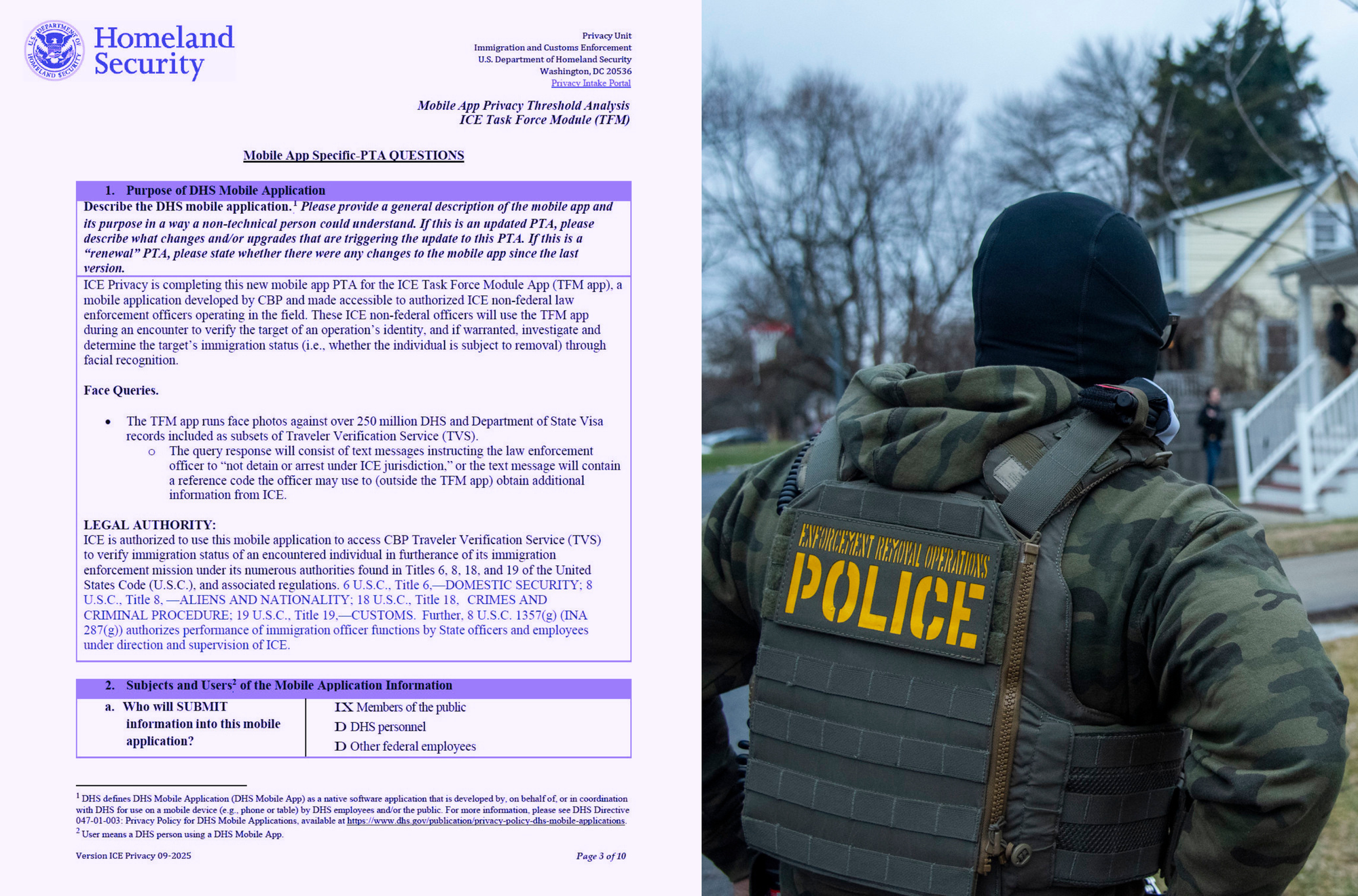
U.S. Immigration and Customs Enforcement is expanding facial recognition deployment across domestic law enforcement by distributing a verification app to over 1,000 agencies nationwide. This represents a significant scaling of biometric AI infrastructure for immigration enforcement, shifting facial recognition from centralized federal use to distributed state and local police networks. The move raises critical questions about accuracy, bias, and mission creep in computer vision systems deployed at scale without uniform oversight, while establishing a precedent for federated AI tool distribution in law enforcement.
Modelwire’s AI-generated summary of coverage from 404 Media.
Modelwire analysis
Analyst takeOur AI-generated reading of the wider context and the next developments to watch.
The real story isn't the facial recognition itself but the distribution model: by pushing a verification app to local agencies rather than running queries through a central federal system, ICE is effectively offloading both operational control and accountability to jurisdictions with wildly inconsistent oversight standards. That federated architecture makes the system far harder to audit or roll back than a single federal deployment would be.
This connects directly to our June 1st coverage of ICE's Paragon spyware contract, where the agency's aggressive redaction of procurement details illustrated a consistent pattern: surveillance infrastructure expands faster than the public accountability mechanisms meant to constrain it. The facial recognition app rollout follows the same playbook, scaling capability while distributing legal exposure across hundreds of local agencies. Neither story exists in isolation; together they sketch an agency that is systematically building layered biometric and signals intelligence capacity with minimal transparency.
Watch whether any of the 1,000+ participating agencies publish their own use policies or accuracy disclosures within the next six months. If none do, that confirms the federated model functions primarily as an accountability diffusion mechanism rather than a genuine decentralization of governance.
This interpretation is generated from the summary above and available source metadata. Our methodology · Report an error
MentionsICE · U.S. Immigration and Customs Enforcement · facial recognition
How this coverage is produced
Modelwire uses AI to generate summaries and context from source headlines, snippets, and selected archive coverage. Automated checks do not verify every claim, and items are not routinely reviewed by a person before publication. Zacaria Solis operates the site. Read the linked source for the full evidence and report errors through our corrections process.
Modelwire summarizes, we don’t republish. The full content lives on 404media.co. If you’re a publisher and want a different summarization policy for your work, see our takedown page.