New startup secures funding for $10 billion Norwegian AI compute hub
Source published ·Modelwire updated
Original coverage: AI Business ↗·How Modelwire adds context
The development
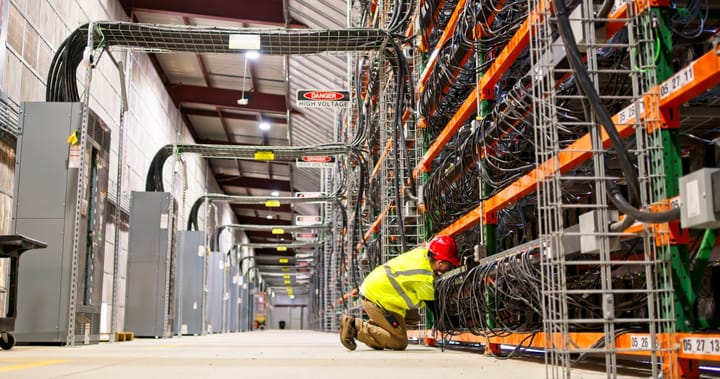
A newly formed infrastructure startup is mobilizing capital at an exceptional pace to construct a $10 billion AI compute facility in Norway, signaling intensifying competition for physical capacity as demand for training and inference resources outpaces supply. The venture's fundraising velocity underscores investor conviction that compute infrastructure remains a structural bottleneck in the AI stack, even as chip availability improves. Norway's selection reflects strategic interest in hydroelectric power and geographic diversification away from saturated US markets, a pattern now reshaping where foundational AI workloads will run.
Modelwire’s AI-generated summary of coverage from AI Business.
Modelwire analysis
Analyst takeOur AI-generated reading of the wider context and the next developments to watch.
The startup is unnamed in coverage, which matters: a $10 billion commitment from an entity with no public track record raises legitimate questions about capital structure, anchor tenants, and whether this is a build-to-lease play or a captive facility for a specific hyperscaler or model lab.
The geographic logic here connects directly to a pattern this site has been tracking. Norway's hydroelectric advantage is the same energy arbitrage argument driving compute buildout away from US markets, and it sits alongside the Commerce Department's $300M GlobalFoundries photonics investment from August 3rd as evidence that physical infrastructure, not just chip design, is where serious capital is now concentrating. That GlobalFoundries story flagged interconnect and packaging as structural bottlenecks in large-scale training clusters; a $10 billion Norway facility will face exactly those constraints at scale. Meanwhile, the inference optimization work detailed by Baseten in the Latent Space piece from August 3rd is a reminder that raw compute capacity and efficient utilization are separate problems, and a new facility this size will need both a tenant base and a software stack to avoid becoming stranded capacity.
Watch whether a named hyperscaler or frontier lab surfaces as an anchor customer within the next six months. Without one, the fundraising velocity looks more like speculative land-grab than contracted demand.
This interpretation is generated from the summary above and the archive coverage cited below. Our methodology · Report an error
Coverage behind this analysis
These archive entries ground the connection in our analysis. They are ordered by source publication date, with links to our coverage and the original sources.
·AI Business
US backs GlobalFoundries photonics push for AI cluster interconnects
The Commerce Department's $300M investment in GlobalFoundries signals a strategic pivot toward domestic photonics manufacturing as a critical layer of AI infrastructure. Photonics and optical materials are essential for high-bandwidth, low-latency interconnects between accelerators in large-scale training clusters, where traditional copper interconnects become a bottleneck. This funding reflects growing recognition that AI compute scaling depends…
MentionsNorway · AI compute infrastructure
How this coverage is produced
Modelwire uses AI to generate summaries and context from source headlines, snippets, and selected archive coverage. Automated checks do not verify every claim, and items are not routinely reviewed by a person before publication. Zacaria Solis operates the site. Read the linked source for the full evidence and report errors through our corrections process.
Modelwire summarizes, we don’t republish. AI Business originally reported this story as “Infrastructure Startup to Build $10 billion AI Factory in Norway”. The full content lives on aibusiness.com. If you’re a publisher and want a different summarization policy for your work, see our takedown page.