DOJ deploys AI detector Pangram against defense counsel filings
Source published ·Modelwire updated
Original coverage: 404 Media ↗·How Modelwire adds context
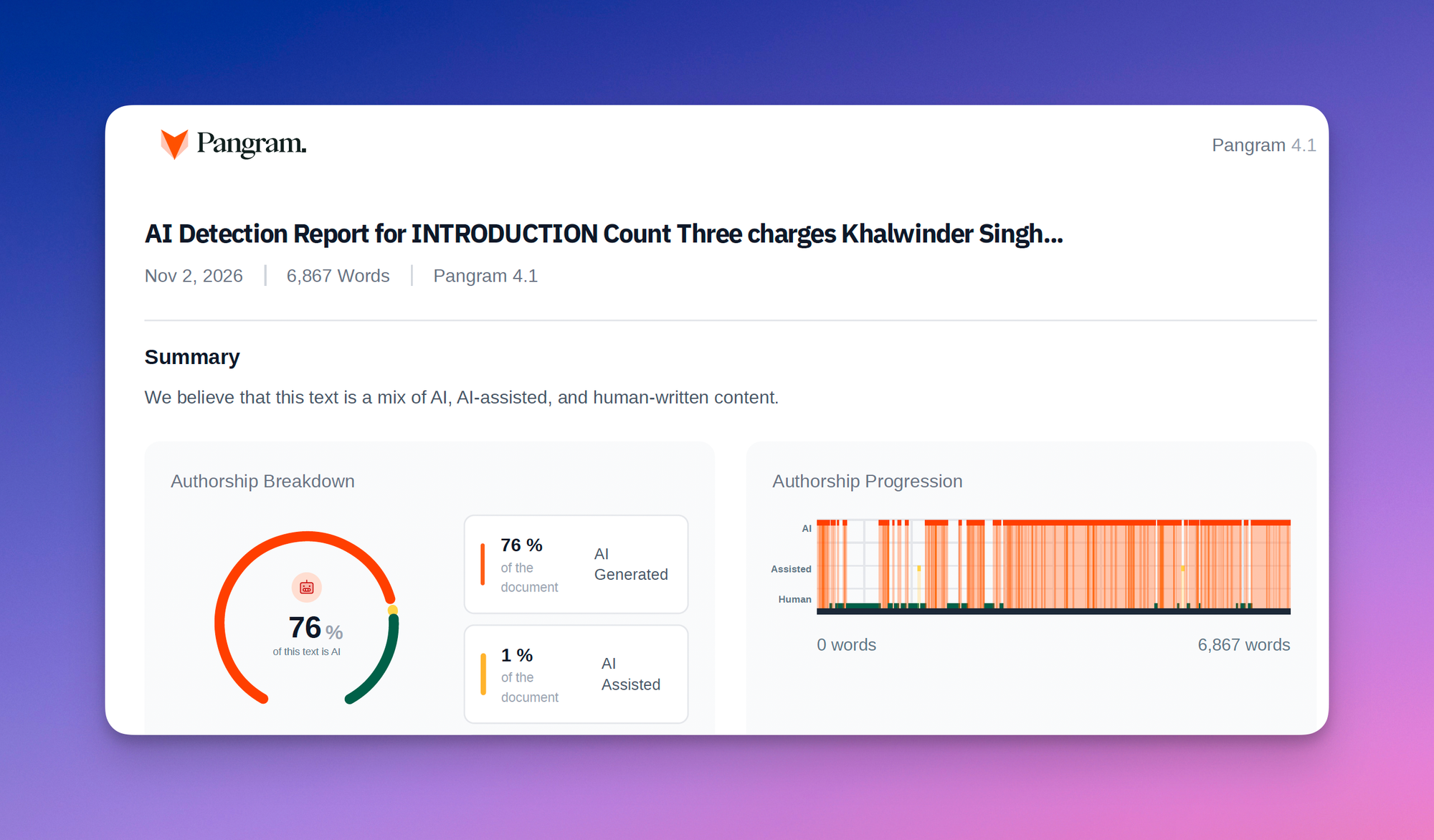
The development
The Department of Justice has deployed Pangram, an AI detection tool, to scrutinize defense filings in legal proceedings, raising questions about the reliability of automated content verification in high-stakes litigation. This development signals growing institutional reliance on detection systems whose accuracy remains contested among researchers and practitioners. The move creates friction between prosecutorial efficiency and defense counsel's ability to leverage modern writing tools without legal jeopardy, establishing a precedent for how government agencies operationalize AI detection at scale within the justice system.
Modelwire’s AI-generated summary of coverage from 404 Media.
Modelwire analysis
Skeptical readOur AI-generated reading of the wider context and the next developments to watch.
The DOJ isn't just using Pangram internally; it's weaponizing detection scores as evidence against defense counsel. The summary notes 'contested accuracy' but doesn't surface the asymmetry: prosecutors gain a compliance shield while defendants face legal jeopardy from a tool that researchers have already shown can be evaded with basic style-transfer prompts.
This directly echoes the arXiv research from November 15th showing that commercial AI-text detectors collapse under author-conditioned style transfer, reducing detection confidence from 100% to 0% in two-thirds of cases. That paper exposed detectors as relying on shallow stylistic fingerprints rather than robust linguistic markers. The DOJ's deployment suggests the agency either hasn't internalized that vulnerability or is accepting it as an acceptable friction cost. Meanwhile, the pattern mirrors how OpenAI's Daybreak tool gained institutional trust through NATO validation (November 17th) despite similar questions about real-world robustness in adversarial contexts.
If defense attorneys successfully challenge Pangram scores in the next 6-12 months by submitting style-transferred versions of the same text that score differently, that proves the tool is unreliable enough to disqualify as evidence. If the DOJ continues using it anyway, that signals detection deployment is about procedural cover rather than accuracy.
This interpretation is generated from the summary above and the archive coverage cited below. Our methodology · Report an error
Coverage behind this analysis
These archive entries ground the connection in our analysis. They are ordered by source publication date, with links to our coverage and the original sources.
·arXiv cs.CL
Gemini author-mimicry defeats QuillBot AI detector in large-scale study
Researchers have demonstrated a critical vulnerability in commercial AI-text detectors by using style-transfer prompts to mask machine-generated content. By conditioning Gemini to rewrite AI outputs in the voice of specific authors, they reduced QuillBot detection scores from a median of 100% to 0% in two-thirds of cases. The technique's effectiveness varied dramatically by author, suggesting…
MentionsDepartment of Justice · Pangram · ChatGPT
How this coverage is produced
Modelwire uses AI to generate summaries and context from source headlines, snippets, and selected archive coverage. Automated checks do not verify every claim, and items are not routinely reviewed by a person before publication. Zacaria Solis operates the site. Read the linked source for the full evidence and report errors through our corrections process.
Modelwire summarizes, we don’t republish. 404 Media originally reported this story as “The Department of Justice Is Using AI Detector Pangram Against Defense Attorneys”. The full content lives on 404media.co. If you’re a publisher and want a different summarization policy for your work, see our takedown page.