
Earlier stories
Every published Modelwire story, newest first. The homepage leads with the weekly overview and this week’s hottest; this is the full collection.

The Korean Telecom Giant at the Center of Anthropic’s Mythos Controversy
Anthropic's decision to take Claude Mythos offline follows White House pressure on the company to cut SK Telecom's access, citing alleged Chinese connections. The move signals escalating geopolitical friction around frontier AI model distribution and raises questions about how national security concerns will reshape access controls for advanced systems. This precedent could fragment the global AI ecosystem, forcing labs to implement country-level restrictions that complicate international partnerships and set a template for future government intervention in model deployment.81

AWS’s New Agentic Tools Trail Rivals, but Respond to Real Problems
AWS is shipping agentic AI capabilities that lag behind OpenAI and Anthropic in raw innovation but directly address customer pain points around integration and operational workflows. The strategic play here is pragmatism over novelty: AWS is betting that enterprises care more about tools that slot into existing infrastructure than cutting-edge model performance. This positions the cloud giant as a consolidator rather than a frontier lab, which matters for the enterprise AI stack's near-term evolution and could slow adoption of best-of-breed point solutions.61

NEA’s Tiffany Luck says enterprises are still figuring out their AI ROI
Enterprise AI spending is hitting a reckoning as organizations confront the gap between hype-driven adoption and measurable returns. After months of aggressive 'tokenmaxxing' culture pushed teams to maximize API consumption, companies like Uber face ballooning costs that forced budget cuts mid-year, while others including Meta and major Claude users are consolidating licenses and killing internal usage metrics. This shift signals a maturing market where CFOs now demand ROI justification rather than blanket AI expansion, reshaping how enterprises approach vendor relationships and internal governance around generative AI.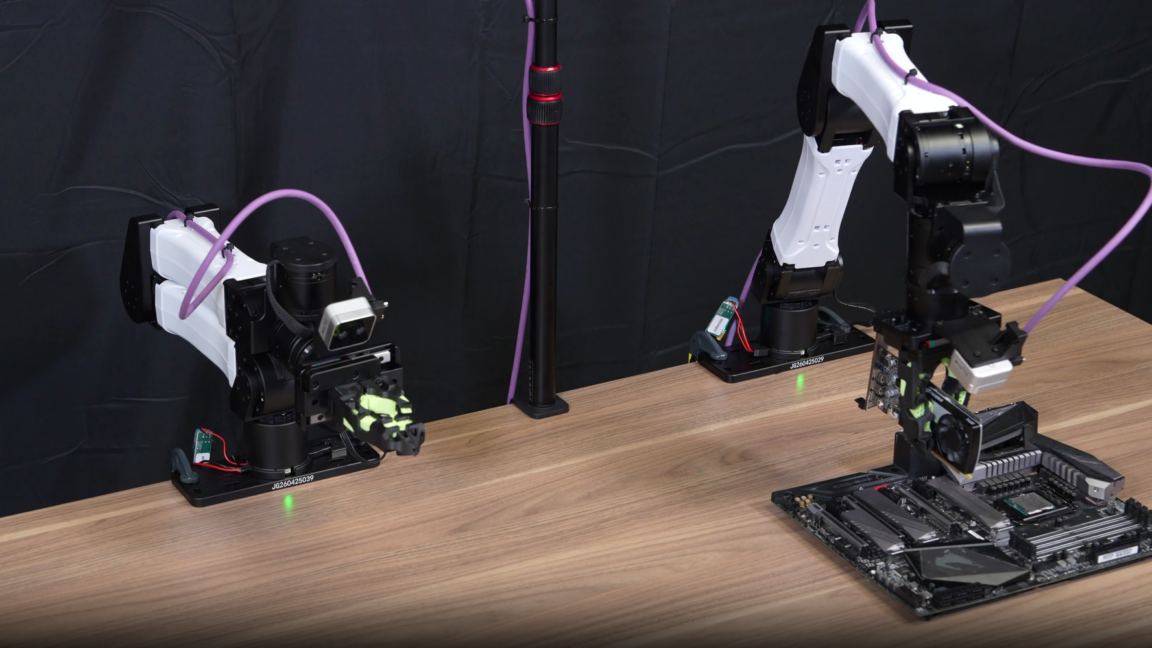
AI coding agents can autonomously direct robot training
NVIDIA is deploying teams of AI coding agents to autonomously oversee robot training loops, marking a shift toward self-directed AI systems managing physical-world learning. This approach treats code-generation LLMs as active supervisors rather than passive tools, enabling robots to iterate on their own behaviors without constant human intervention. The development signals growing confidence in agentic AI for high-stakes domains and hints at a future where AI systems manage both digital and embodied learning cycles with minimal oversight.
World leaders want American AI. They just don’t want America to be able to turn it off.
Geopolitical tension over AI access surfaced at the G7 when France and India flagged vulnerability to U.S. supply-chain leverage. The concern centers on American dominance in frontier model deployment and the risk of sudden service termination, a scenario the recent Anthropic outage crystallized. This signals a structural shift in how nations view AI sovereignty and dependency, likely to accelerate non-U.S. model investment and regional AI infrastructure buildouts. For the industry, it underscores that technical capability alone no longer determines competitive advantage; control over deployment and continuity now shapes geopolitical alignment.
Microsoft researcher builds a working neural network out of goats in Age of Empires II to critique AI science
A Microsoft researcher constructed a functional neural network using Age of Empires II game mechanics, goats, and environmental objects to expose methodological flaws in contemporary AI research. Analysis of 315 papers revealed that over half presuppose language models possess human-like cognition before testing begins. The project illustrates how substrate-agnostic mathematical systems acquire anthropomorphic qualities through interface design alone, challenging the scientific rigor of claims about model sentience and reasoning capabilities.73

Anthropic becomes first AI startup to join the Frontier carbon removal coalition
Anthropic's entry into the Frontier coalition signals a strategic pivot by a leading AI lab toward climate accountability and corporate responsibility. The coalition, which now commands over $915M in fresh pledges, focuses on scaling carbon removal technologies. This move reflects growing pressure on frontier AI companies to address the environmental footprint of large-scale model training and deployment, positioning Anthropic as the first major AI developer to formally commit to the coalition's framework. The decision carries implications for how AI labs manage ESG positioning and whether carbon removal pledges become table stakes for AI industry legitimacy.
Anthropic got hit by export rules nobody understands
Anthropic's deployment of Fable 5 and Mythos 5 has been halted following Trump administration export controls targeting foreign national access to advanced AI systems. The blanket restriction, which blocks even US-based employees from using the models, exposes a critical friction point between frontier AI development and geopolitical regulation. This move signals that export enforcement may now operate at the application layer rather than weights/compute alone, forcing labs to choose between global operations and domestic capability access. The incident underscores how policy uncertainty can instantly disable production systems and reshape go-to-market strategy for leading AI companies.
Operating a Humanoid With Your Body Is a Hot Job in China’s Hardware Capital
Shenzhen-based IO-AI Tech is scaling humanoid robot deployment through remote teleoperation, where workers control units via VR interfaces. This model addresses a critical bottleneck in robotics commercialization: bridging the gap between autonomous capability and real-world task execution. Rather than waiting for full autonomy, the company monetizes human expertise by distributing control across multiple operators, effectively creating a hybrid labor-automation layer. The approach signals how hardware AI ventures are solving the last-mile problem in manufacturing hubs, turning skilled labor into a scalable service layer for robotic systems.65

Amazon, Nvidia, and AMD bet $310 million on AI startup building 3D world models
Major infrastructure players Amazon, Nvidia, and AMD are collectively investing $310 million into Odyssey ML, a startup focused on 3D world models, signaling a strategic pivot toward embodied AI systems beyond language. The $1.45 billion valuation reflects growing conviction that world models, which simulate physical environments, represent the next frontier after LLM-dominated cycles. Backing from Google's chief scientist Jeff Dean and intelligence-linked IQT underscores both commercial and national-security interest in this capability class. This consolidation of compute giants around a single startup suggests world models are transitioning from research curiosity to infrastructure priority.90

Social media’s next evolution: User-controlled algorithms
Major social platforms are shifting recommendation architecture from opaque algorithmic control to user-facing customization layers. This represents a structural pivot in how ML systems mediate content discovery: instead of black-box ranking, platforms now expose algorithmic levers directly to end users. The move reflects mounting pressure on algorithmic transparency and user agency, forcing ML teams to build interpretable preference systems and real-time ranking adjustments. For AI practitioners, this signals a broader industry trend toward explainable recommendation systems and the technical debt of retrofitting user control into systems designed for centralized optimization.
NEA’s Tiffany Luck on AI IPOs, personal agents, and the ROI reckoning
The AI spending boom of early 2026 has hit a reckoning. After months of aggressive 'tokenmaxxing' culture pushed companies to maximize AI consumption regardless of ROI, major players are now facing the financial consequences. Uber exhausted its annual AI budget in weeks, Meta dismantled internal usage leaderboards, and organizations are selectively cutting expensive model licenses like Claude. This shift signals a maturing market where AI adoption metrics no longer trump unit economics, forcing enterprises to justify spend against measurable business outcomes rather than chase adoption for its own sake.
Native Active Perception as Reasoning for Omni-Modal Understanding
OmniAgent introduces a fundamental shift in video understanding by replacing the computationally wasteful 'watch-it-all' paradigm with active perception. The system models video comprehension as a POMDP-based reasoning loop, where an agent selectively attends to audio-visual content on-demand and distills it into persistent memory, decoupling reasoning cost from video length. This addresses a critical scaling bottleneck in multimodal AI: as video contexts grow, passive models face quadratic cost growth. The work's introduction of Agentic Supervised Fine-Tuning signals a broader trend toward agent-native training methods that embed decision-making into model architecture rather than bolting it on post-hoc. For practitioners building long-context video systems, this represents a viable alternative to brute-force scaling.62

Learning User Simulators with Turing Rewards
Researchers propose Turing-RL, a reinforcement learning framework that trains user simulator models by optimizing for behavioral indistinguishability rather than single-response matching. Instead of maximizing log probability against ground truth, the approach deploys an LLM judge to reward responses that could plausibly come from a real user given interaction history. This shift from supervised cloning to adversarial realism unlocks applications in agent training, personalization evaluation, and social science simulation where behavioral fidelity matters more than exact reproduction. The technique addresses a fundamental gap in synthetic user generation for interactive systems.62

Freeing the Law with LOCUS: A Local Ordinance Corpus for the United States
Researchers have assembled LOCUS, a machine-readable corpus spanning nearly all U.S. municipal and county ordinance codes, addressing a critical gap in legal AI training data. Local regulations governing zoning, housing, licensing, and public health have remained fragmented across vendor platforms unsuitable for bulk research access. This release enables legal AI systems to train on ordinance text at scale, potentially unlocking new capabilities in regulatory compliance, policy analysis, and automated legal research across domains where local law shapes everyday enforcement. The corpus represents infrastructure that could accelerate downstream legal AI applications.62

Rethinking Reward Supervision: Rubric-Conditioned Self-Distillation
Researchers propose Rubric-Conditioned Self-Distillation, a post-training framework that replaces noisy chain-of-thought annotations and opaque scalar rewards with structured, criterion-level feedback. The method conditions teacher models on fine-grained rubrics during on-policy distillation, addressing a core bottleneck in reasoning model development: how to extract actionable learning signals from imperfect supervision. This shifts the post-training paradigm from binary correctness signals toward interpretable, multi-dimensional feedback, potentially reducing annotation costs while improving reasoning quality across diverse problem types.62

World model maker Odyssey nabs $1.45B valuation backed by Amazon and other big names
Odyssey's $1.45B valuation signals investor conviction that world models represent the next major AI frontier beyond large language models. The startup's backing from Amazon and other institutional players reflects a strategic pivot in the industry toward systems that can simulate and predict physical environments and complex dynamics. This funding milestone matters because it validates a technical direction that could reshape how AI systems reason about causality and planning, potentially unlocking capabilities LLMs alone cannot achieve. For practitioners, it signals where capital and talent will concentrate over the next cycle.
Explaining Attention with Program Synthesis
Researchers have developed a method to reverse-engineer transformer attention heads by synthesizing executable Python programs that replicate their behavior on held-out data. Rather than treating attention as a black box, the approach uses a language model to generate symbolic descriptions of attention patterns, then validates these programs against unseen examples. This work directly addresses a core interpretability bottleneck: converting opaque neural computations into human-readable logic. For practitioners building production systems, this technique could enable safer auditing of model internals and faster debugging of unexpected behaviors in deployed transformers.62

Diffusion-Proof: Recipe for Formal Theorem Proving Beyond Auto-Regressive Generation
Diffusion-based language models are emerging as a structural alternative to autoregressive architectures for formal mathematics, where token-by-token generation compounds errors over long proofs. This work positions diffusion LLMs as a solution to coherence degradation in theorem proving, a domain where reasoning chains demand strict logical consistency. If validated, the shift could reshape how the field approaches formal verification and mathematical reasoning, moving beyond the next-token prediction paradigm that has dominated LLM scaling.62

Zhipu AI's GLM-5.2 closes in on closed-source leaders in coding marathons
Zhipu AI's GLM-5.2 represents a meaningful narrowing of the open-source to closed-source capability gap in specialized domains. The model's 1-million-token context window and MIT licensing lower barriers to deployment, while its near-parity performance on FrontierSWE (a benchmark measuring sustained coding reasoning over hours) signals that open alternatives are catching up on practical, long-horizon tasks. However, the persistent gap in general reasoning suggests the frontier remains stratified by task type, not just scale. For practitioners, this expands viable open options for code-heavy workloads; for labs, it underscores competitive pressure from Chinese players in the open-weights race.73

🔬 The Limits of AI in Science - Why We Need Self-Driving Labs , Joseph Krause, Radical AI
Radical AI's self-driving lab platform represents a shift in how AI accelerates materials science: moving from model-centric bottlenecks to closed-loop experimental automation. The startup's six-month track record of 1,200 alloy syntheses, including 300 novel compositions entering commercial development, signals that autonomous hypothesis generation paired with robotic lab infrastructure can outpace traditional DARPA-scale programs by an order of magnitude. This matters beyond materials because it reframes AI's role in hard sciences from prediction to active experimentation, with geopolitical implications as China races similar capabilities.85

Does VLA Even Know the Basics? Measuring Commonsense and World Knowledge Retention in Vision-Language-Action Models
Researchers have exposed a critical blind spot in embodied AI: vision-language-action models fine-tuned on robotics tasks often lose commonsense and factual knowledge from their pretrained foundations, yet this degradation has been hard to measure separately from control failures. Act2Answer, a new evaluation protocol, grounds knowledge benchmarks in physical action by converting multiple-choice questions into tabletop manipulation episodes where agents select answers through object placement. This work matters because it clarifies whether VLA failures stem from forgotten knowledge or poor motor generalization, directly informing how practitioners should architect and train embodied systems for real-world deployment.62

Two-thirds of Americans think AI is advancing too quickly
Public sentiment on AI deployment is fracturing. While chatbot adoption has surged from 33 percent in 2024 to 49 percent today, a majority of Americans now express concern that the technology is maturing faster than society can absorb it. This perception gap between usage growth and comfort levels signals a critical inflection point for the industry: mainstream adoption is accelerating, but trust and regulatory readiness are lagging. For product teams and policymakers, the data underscores mounting pressure to demonstrate safety and control mechanisms before skepticism hardens into resistance.
Quoting Charity Majors
Charity Majors argues that 2025 marked a structural inversion in software economics: code generation shifted from scarce and costly to abundant and near-free, collapsing the traditional incentive to minimize, reuse, and maintain code carefully. This abundance paradox now demands a counterintuitive response from engineering teams: stricter discipline, not looser standards. The insight cuts to a core tension in the AI-augmented development era: cheap code production can mask technical debt and architectural fragility unless paired with rigorous testing, documentation, and design practices. For engineering leaders, this reframes the productivity debate from "how much code can we generate" to "how do we maintain quality when generation is frictionless."
Only 16 percent of Americans think AI will have a positive impact on society, a new study shows
Public sentiment toward AI has sharply diverged from investor enthusiasm, with a Pew Research survey revealing only 16 percent of Americans expect positive societal outcomes. This widening perception gap signals a critical credibility challenge for the industry as deployment accelerates. The finding underscores how AI adoption narratives crafted by technologists and capital markets have failed to resonate with mainstream audiences, potentially constraining long-term policy flexibility and consumer adoption of AI-integrated products and services.
The White House Wants Anthropic to Block All Jailbreaks. That May Not Be Possible
The Trump administration is conditioning Anthropic's rerelease of Fable 5 on eliminating all jailbreak vulnerabilities, a demand that security researchers argue is technically infeasible. This collision between regulatory expectation and cryptographic reality exposes a fundamental tension in AI governance: policymakers are mandating outcomes that may violate the laws of information security itself. The episode signals how political pressure on frontier labs could force impossible compliance choices, reshaping the regulatory landscape for model deployment and potentially accelerating industry fragmentation around safety standards.76

Beyond Algorithms: Conceptual Innovation in Medical Imaging AI
A new perspective paper challenges the field's fixation on algorithmic performance gains in medical imaging AI, arguing that computational sophistication has outpaced critical examination of problem framing, evaluation criteria, and clinical validity. The work identifies a structural misalignment in how the research community incentivizes and trains practitioners, suggesting that breakthrough progress requires rethinking what success means rather than optimizing within existing task definitions. This reframing matters for practitioners building clinical systems, as it exposes how benchmark-driven development can obscure whether AI actually solves clinically meaningful problems.62

Structured Inference with Large Language Gibbs
Researchers propose Large Language Gibbs, a probabilistic inference method that treats LLM token conditionals as Markov chain transition operators for structured reasoning. Rather than relying on single-pass autoregressive sampling, the approach iteratively resamples variables conditioned on others, eliminating order-dependent biases and converging to a stationary distribution that balances competing local constraints. This addresses a fundamental tension in using LLMs for probabilistic tasks: how to extract coherent joint distributions from models trained on next-token prediction. The technique opens pathways for more principled uncertainty quantification and structured problem-solving with language models.62

Detecting Hidden ML Training With Zero-Overhead Telemetry
Researchers have demonstrated that GPU telemetry alone can reliably detect unauthorized ML training workloads, achieving 98% accuracy across multiple hardware generations and evasion attempts. This work directly challenges the feasibility of compute governance schemes that rely on hardware monitoring to enforce AI safety and compliance policies. The finding matters because it exposes a critical vulnerability in proposed regulatory infrastructure: if adversaries can systematically evade detection, monitoring-based oversight of large-scale model training becomes ineffective, forcing policymakers and infrastructure providers to rethink how to enforce constraints on AI development.62