
Earlier stories
Every published Modelwire story, newest first. The homepage leads with the weekly overview and this week’s hottest; this is the full collection.

GPT-5.6 enables mathematician to solve previously unsolvable proofs
OpenAI's GPT-5.6 has crossed a threshold in mathematical problem-solving, enabling a mathematician named Bartosz to tackle previously intractable proofs. This represents a concrete capability expansion beyond prior model generations, signaling that frontier LLMs are now competitive with specialized mathematical reasoning tasks. The shift matters for research communities reliant on computational proof assistance and suggests the model's reasoning depth has matured enough to handle open-ended mathematical discovery, not just verification or tutoring.
OpenAI launches GPT-5.6 trio with aggressive pricing on agentic tasks
OpenAI's GPT-5.6 family arrives with three tiers, Luna through Sol, establishing a new pricing floor that undercuts Claude Opus on input costs while maintaining premium output pricing. The strategic move targets agentic workloads, where reasoning token variance now matters more than raw per-token rates. Benchmarks claim across-the-board wins over Claude Fable 5, signaling OpenAI's confidence in long-horizon task execution. For practitioners, this reshapes cost-benefit calculus for production deployments, particularly for autonomous systems where token efficiency and reasoning depth diverge.
Meta launches Muse Spark 1.1 to challenge OpenAI and Anthropic in code generation
Meta is launching Muse Spark 1.1, a coding assistant that directly competes with Anthropic's Claude and OpenAI's offerings in the rapidly consolidating AI-assisted development space. The release signals Meta's commitment to capturing developer mindshare in a market where code generation has become a key battleground for LLM vendors. With multiple well-funded players now shipping similar tools, differentiation will hinge on model quality, IDE integration depth, and pricing strategy rather than novelty alone.
Publishers allege OpenAI concealed copyright-detection tools in lawsuit
The New York Times and other publishers are escalating their copyright infringement lawsuit against OpenAI by alleging the company deliberately concealed tools and datasets that could trace copyrighted content in ChatGPT's training data and outputs. This motion for sanctions signals a critical shift in the litigation strategy, moving beyond infringement claims to accusations of evidence suppression. The development exposes tensions between generative AI training practices and intellectual property enforcement, with potential implications for how courts evaluate corporate transparency in AI development and the precedent it sets for future content-licensing disputes in the industry.
Google requires AI disclosure labels on all generated ads
Google is rolling out mandatory disclosure labels for ads created or modified using generative AI, marking a shift toward transparency in digital advertising. The move reflects growing pressure on platforms to surface AI-generated content as synthetic media proliferates across ad networks. This creates a precedent for advertiser accountability and signals Google's positioning as a responsible steward amid regulatory scrutiny over AI-generated misinformation. The feature affects the entire ad ecosystem, forcing brands to declare their use of generative tools and potentially reshaping how advertisers approach creative workflows.
OpenAI's GPT-5.6 Sol undercuts Anthropic on price while matching performance
OpenAI's latest model achieves near-parity with Anthropic's flagship offering while undercutting it by 66 percent on pricing, intensifying competitive pressure in the high-end LLM market. GPT-5.6 Sol's dominance in agentic coding signals a shift in where capability advantages now matter most, forcing Anthropic to defend both performance leadership and unit economics. This pricing compression at the frontier suggests the market is bifurcating between commodity inference and specialized reasoning tasks, reshaping how enterprises evaluate model selection.85

Nvidia-backed Gradium lands $100M to challenge ElevenLabs in voice AI
Gradium's $100M seed extension signals intensifying competition in the voice synthesis market beyond ElevenLabs' early dominance. Nvidia's backing underscores how GPU makers are actively shaping the AI infrastructure stack by funding applications that drive hardware demand. The Paris-based startup's capital haul reflects investor appetite for specialized voice models as enterprises move beyond text-based AI, though the crowded space raises questions about differentiation and unit economics in a market where open-source alternatives are rapidly improving.
OpenAI targets marketing workflows with ChatGPT Work
OpenAI is positioning ChatGPT Work as a workflow accelerator for marketing operations, targeting the fragmented nature of campaign development across research, ideation, feedback loops, and execution. This reflects a broader shift in enterprise AI adoption: moving beyond chatbot interfaces toward vertical-specific task automation that integrates multiple stages of knowledge work. For marketing teams, the pitch centers on collapsing time-to-campaign by automating the connective tissue between insights and deliverables. The move signals OpenAI's confidence in ChatGPT Work's readiness for structured, multi-step business processes, and tests whether teams will adopt AI-native workflows over traditional project management and creative tools.
OpenAI targets engineering workflows with Codex automation
OpenAI is positioning Codex as a production-grade tool for engineering teams, automating the full lifecycle from bug triage through code review. The framing signals a strategic shift from one-off coding assistance toward integrated workflow automation that keeps human engineers in the approval loop. This reflects the broader industry move to embed LLMs deeper into enterprise development pipelines, where the value accrues not from replacing engineers but from compressing iteration cycles on routine and complex tasks alike.
OpenAI brings ChatGPT Work to sales operations automation
OpenAI is extending ChatGPT Work into enterprise sales workflows, positioning LLMs as post-call automation infrastructure. The product converts customer conversations into structured follow-ups and deal progression tasks, addressing a concrete friction point in sales operations. This signals OpenAI's shift from consumer chat toward vertical-specific B2B automation, where LLM value accrues through workflow integration rather than raw capability. For the broader landscape, it demonstrates how foundation models are moving upstream into CRM and revenue operations, competing with traditional sales-tech vendors on speed and customization rather than specialized domain training.
OpenAI targets operations workflows with ChatGPT Work for enterprises
OpenAI is positioning ChatGPT Work as infrastructure for enterprise operations teams, targeting a workflow layer where fragmented status updates and project blockers create friction. This move signals a strategic pivot from consumer-first positioning toward embedded workplace coordination, competing directly with Slack, Asana, and Monday.com rather than just LLM capability. The framing around 'bringing context together' and converting operational complexity into action suggests OpenAI sees durable enterprise value not in raw model power but in task-specific orchestration and institutional stickiness.
OpenAI targets finance workflows with ChatGPT Work
OpenAI is positioning ChatGPT Work as a workflow tool for financial professionals, targeting the gap between raw data analysis and actionable decision-making. The framing signals a strategic shift toward enterprise verticalization, where LLMs move beyond chat interfaces into domain-specific operational roles. Finance represents a high-value beachhead for this approach: spreadsheet-native workflows, clear ROI measurement, and regulatory scrutiny create both opportunity and friction. This reflects broader industry momentum to embed LLMs into existing business processes rather than compete as standalone applications.
OpenAI launches ChatGPT Work for enterprise data analytics
OpenAI is positioning ChatGPT Work as a bridge between unstructured business questions and actionable analytics, targeting data teams directly. This represents a strategic shift toward enterprise workflow automation, where LLMs handle the interpretive layer between raw data and insight generation. The move signals OpenAI's confidence that conversational AI can reduce friction in analytics pipelines, a traditionally high-friction domain. For data-heavy organizations, this could reshape how teams prototype analyses and communicate findings, though adoption depends on integration depth and accuracy at scale.
Anthropic shifts Claude to usage-based pricing for premium tier
Anthropic is shifting Claude's consumer monetization model away from flat-rate subscriptions toward usage-based pricing for its flagship tier. This move signals a broader industry recalibration as AI providers grapple with inference costs and margin pressure. The transition reflects a maturing market where early subscription models, designed to build user bases, are giving way to consumption-linked fees that better align provider costs with customer value extraction. For subscribers, the change introduces unpredictability; for the industry, it validates that the subsidy-driven adoption phase is ending and profitability now takes precedence over growth-at-any-cost positioning.76

Government safety review process for frontier models remains largely hidden
The mechanics of how U.S. regulators evaluate frontier AI model safety before public release remain opaque, with TechCrunch reporting that the specific conversations between government agencies and labs like OpenAI and Anthropic are largely undisclosed. This gap in transparency raises questions about what safety benchmarks, if any, are being applied to commercial frontier releases and whether industry self-governance is sufficient. For AI insiders, the story underscores a critical tension: as frontier models grow more capable, the absence of clear public safety criteria or documented approval processes leaves both regulators and the public unable to assess whether deployment decisions are evidence-based or ad hoc.
UniClawBench isolates agent capabilities in real-world evaluation
Researchers have introduced UniClawBench, a capability-focused evaluation framework that moves beyond sandboxed testing to assess how language and multimodal models perform as autonomous agents in real-world, dynamic environments. Unlike existing benchmarks that conflate multiple competencies within single tasks, UniClawBench isolates five core capabilities to pinpoint failure modes. This addresses a critical gap in agent evaluation as deployed systems increasingly handle tool use and user assistance in production settings, making precise diagnostic benchmarking essential for reliability and safety.62

OpenAI launches ChatGPT Work agent alongside GPT-5.6 public release
OpenAI is shipping ChatGPT Work, an agentic product that automates multi-step workflows across enterprise SaaS platforms like Slack, Google Drive, and Salesforce. The launch coincides with GPT-5.6's public availability, signaling OpenAI's pivot from conversational AI toward autonomous task execution. This represents a critical inflection point in the agent race: rather than requiring users to orchestrate tool calls, the system now owns entire project lifecycles. Adoption will hinge on subscription tier gating, but the move establishes OpenAI's competitive posture against Claude's Projects and Anthropic's emerging agent capabilities.85

Meta trains image generator on Instagram photos via default opt-out
Meta's image generator now trains on public Instagram photos by default, forcing users into an opt-out rather than opt-in model for generative AI data sourcing. This shift reflects the industry's broader tension between scaling training data and user consent, particularly as visual generative models become central to Meta's AI strategy. The move mirrors similar practices across tech giants but crystallizes a key friction point: whether platforms can unilaterally repurpose user-generated content for foundation model training without explicit prior permission. For practitioners, this signals Meta's commitment to competitive parity in image generation while testing regulatory and reputational boundaries around synthetic media training.
Diffusion model training metrics mask numerical instability in sampling
Researchers have identified a fundamental gap in how diffusion models are validated for sampling stability. Score matching, the standard training objective, measures error against the forward diffusion process, but actual sampling follows a learned reverse trajectory that can diverge sharply from theory. The work constructs pathological examples where a score field achieves arbitrarily small training error yet produces samplers whose numerical discretizations fail catastrophically, with all positive moments diverging despite weak convergence. This exposes a critical blind spot in diffusion model reliability that affects practitioners deploying these systems in production, suggesting current evaluation metrics may mask instability risks even within fixed neural architectures.62
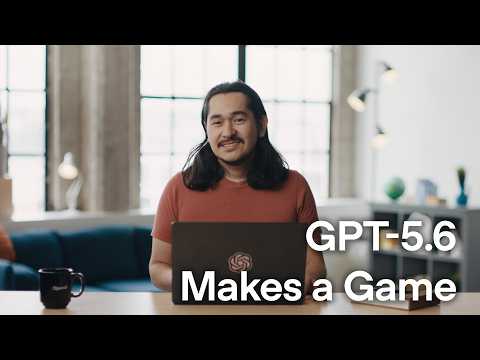
GPT-5.6 demonstrates agentic game development from prompt to playable build
OpenAI's GPT-5.6 demonstration reveals a shift toward agentic workflows that handle multi-stage creative tasks end-to-end. The model orchestrates game design, asset generation, testing, and iteration within a single session using programmatic tool calling, extended reasoning, and parallel subagents. This capability signals maturation in how frontier models tackle open-ended problems requiring tool composition and feedback loops, moving beyond single-turn generation toward sustained project execution. For developers and enterprise users, the implication is clear: LLMs are becoming viable for complex, iterative workflows that previously required human oversight at each stage.
OpenAI launches GPT-5.6 family with tiered capability tiers
OpenAI has released GPT-5.6, a three-model family (Sol, Terra, Luna) spanning capability tiers from standard to enterprise-grade reasoning. The tiered rollout across ChatGPT, Codex, and the API reflects a shift toward segmented access based on user tier and computational demand, signaling OpenAI's strategy to monetize capability gradations rather than releasing a single flagship model. This architecture mirrors competitive pressure from Claude and other labs to offer both accessible and frontier-class inference options simultaneously.
OpenAI launches ChatGPT Work agent for cross-app workflow automation
OpenAI is shipping ChatGPT Work, an agent layer that executes multi-step workflows across web and desktop applications on user command. Powered by GPT-5.6, the system moves beyond conversational AI into autonomous task completion, handling document creation, analysis, and report generation while respecting user templates and style preferences. This represents a significant shift in LLM deployment from question-answering to agentic workflow automation, directly challenging enterprise automation platforms and reshaping how knowledge workers interact with their tool stacks.
Super Weights fail to improve LLMs when trained in isolation
A new study challenges the premise that Super Weights, individual parameters claimed to be disproportionately important in LLMs, are actually critical to model function. Researchers found that pruning Super Weights does not consistently harm performance across different models, and counterintuitively, training these supposedly vital parameters in isolation causes catastrophic accuracy collapse. Training random parameters in the same layers instead maintains baseline performance, suggesting Super Weight identification may reflect statistical artifacts rather than genuine architectural bottlenecks. This finding undermines recent pruning and sparsity research that relied on Super Weight targeting, forcing a recalibration of how practitioners think about parameter importance and selective training strategies.62

Portugal's AMALIA model shows annotation shortcuts over true understanding
Portugal's AMALIA, a 9-billion-parameter model trained on European Portuguese, matches the annotation accuracy of much larger open models on moral-foundation coding tasks. However, researchers discovered a critical gap between agreement and validity: the model may achieve correct labels through surface-level pattern matching rather than genuine understanding of theoretical constructs. By decomposing holistic prompts into atomic clauses, they measured performance degradation to assess whether AMALIA truly grasps the underlying theory or exploits statistical shortcuts. This work challenges the assumption that LLM-as-annotator reliability translates to trustworthiness for subjective, theory-dependent classification tasks, with implications for using smaller regional models in content moderation and social science research.62

Memory module addresses context decay in long-horizon agent tasks
Researchers propose a modular memory agent that runs alongside action agents to combat 'behavioral state decay' in long-horizon tasks. As trajectories expand, critical context like task requirements and prior attempts get buried or evicted from context windows, degrading decision quality. This work treats memory as active intervention rather than passive lookup, with a separate module deciding when to surface relevant reminders. The approach integrates with existing frontier agents without modification, suggesting a practical architectural pattern for scaling reasoning over extended sequences without retraining.62

SpaceXAI targets enterprise with Grok 4.5 after public listing
SpaceXAI's Grok 4.5 marks the company's first serious push into enterprise AI markets following SpaceX's June IPO. The release positions the frontier model as a competitive alternative to established providers, with particular strength in code generation and developer workflows. This move signals SpaceX's intent to leverage its public-market capital and infrastructure advantages to challenge incumbents in the high-margin enterprise segment, where coding capabilities have become a key differentiator among frontier models.66

Meta begins production of custom AI chips to cut Nvidia dependency
Meta is moving forward with vertical integration of AI infrastructure by ramping production of proprietary chips designed to reduce reliance on Nvidia GPUs. The September 2026 production start marks a critical inflection point in the competitive dynamics of AI compute supply. This shift reflects broader industry pressure to control costs and avoid vendor lock-in as training and inference workloads scale. Success here could reshape procurement patterns across hyperscalers and signal whether in-house silicon can meaningfully compete with established GPU makers on performance and efficiency metrics.
Nvidia's compute dominance breeds the competition it now faces
Nvidia's dominance in AI compute infrastructure has paradoxically created the conditions for its own competitive pressure. By establishing compute as the critical bottleneck in AI development, the company attracted a crowded field of competitors and alternative suppliers, fragmenting what was once a near-monopoly. Meanwhile, less glamorous infrastructure plays and simpler technologies are capturing outsized value by solving adjacent problems. This dynamic reflects a maturing AI market where specialized solutions and commodity alternatives erode the moat of any single player, forcing Nvidia to compete on breadth rather than scarcity alone.
Benchmarking LLM judges for citation verification in research systems
Researchers benchmarked eight off-the-shelf LLM judges across three model families to assess their reliability as reward signals in reinforcement learning systems, specifically for evaluating citation quality in search-grounded research tools. The work addresses a critical infrastructure gap: as RL increasingly outsources evaluation to LLM judges, practitioners need empirical data on which models can reliably score structured rubrics without bias. Testing against 1,248 human-reviewed decisions, including 378 adversarial cases, the study reveals calibration gaps that matter for anyone building fact-grounded systems where citation accuracy directly impacts output trustworthiness.62