OpenAI (YouTube)
https://www.youtube.com/@OpenAI · Editorial weight 7/10

OpenAI brings GPT-Live-1 voice agents to production API
OpenAI has moved GPT-Live-1 from research preview into production API availability, enabling developers to embed real-time voice agents that process audio bidirectionally into applications. This represents a significant shift in how conversational AI reaches end users: rather than ChatGPT as a standalone interface, the capability now becomes a building block for third-party developers to compose into their own products. The move signals OpenAI's strategy to deepen API-first distribution and compete for enterprise voice-agent workloads against specialized competitors. Developers can now layer their own models and infrastructure choices on top of the underlying voice capability, expanding the addressable market beyond OpenAI's direct consumer offerings.
OpenAI launches hosted Agents API for production autonomous workflows
OpenAI's Agents API shifts agentic AI from research prototype to production infrastructure by offering a hosted runtime for autonomous workflows. The system integrates Model Context Protocol for tool connectivity and enforces structured execution patterns like runbook following and evidence collection, addressing a critical gap between lab demos and enterprise deployment. This move signals that agent reliability and auditability now matter as much as raw capability, reshaping how teams will architect AI-driven incident response and operational automation.
Blind brothers leverage ChatGPT to run nonprofit and navigate independently
Bradford and Bryan Manning demonstrate how multimodal LLM capabilities are reshaping accessibility for blind and low-vision users. By converting visual data into actionable audio and text, ChatGPT enables the brothers to navigate independently, manage their nonprofit's operations, and reduce friction in tasks previously requiring sighted assistance. This case illustrates a critical emerging use case for LLMs: accessibility-driven independence rather than convenience optimization. The story signals how foundation models are beginning to close capability gaps for disabled communities, potentially reshaping both product design priorities and the accessibility market itself.
Two-person ATV company scales to compete with major entertainment firms using ChatGPT
OpenAI's case study of ATV Big Air Tour demonstrates how LLMs are reshaping operational capacity for resource-constrained businesses. A two-person team now competes with major entertainment firms by offloading marketing strategy, partnership evaluation, inventory management, and real-time event logistics to ChatGPT. This pattern signals a structural shift in small business competitiveness: AI-augmented workflows are collapsing the labor multiplier traditionally required to scale. The story matters less as product validation and more as evidence that LLM adoption is already reshaping competitive dynamics outside tech, where margin-thin operations gain outsized leverage from automation.
De la Fuente Lab uses ChatGPT to compress antibiotic discovery from years to hours
The de la Fuente Lab is leveraging ChatGPT and Codex to compress antibiotic discovery timelines from years to hours by mining genetic sequences from organisms like woolly mammoths and snake venom for novel antimicrobial compounds. This represents a concrete shift in how LLMs accelerate domain-specific research workflows, particularly in biotech where computational bottlenecks have historically constrained innovation cycles. With antimicrobial resistance projected to double fatalities by 2050, the ability to rapidly screen and identify candidate molecules signals a meaningful intersection between generative AI capability and urgent public health infrastructure needs.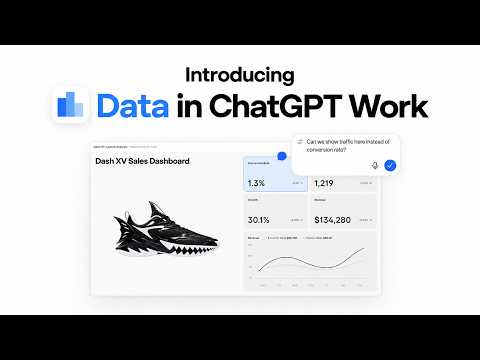
OpenAI embeds data agent into ChatGPT Work for enterprise analytics
OpenAI is embedding enterprise data integration directly into ChatGPT Work, positioning LLMs as the interface layer for corporate analytics. The Data agent plugin lets teams query internal databases and generate dashboards through natural language, collapsing the gap between raw data and actionable insight. This move signals a strategic shift: LLMs are becoming the primary access point for business intelligence, potentially displacing traditional BI tools and SQL workflows. For enterprises, it lowers friction to data exploration; for the AI landscape, it demonstrates how foundation models are consolidating roles across the software stack.
OpenAI deploys GPT-6 Astra to automate enterprise desktop workflows
OpenAI has upgraded ChatGPT Work to run on GPT-6 Astra, positioning the model as purpose-built for enterprise productivity. The shift signals a strategic pivot toward autonomous task execution: Astra can now operate desktop and browser applications independently, filling forms, updating records, and scheduling meetings without native integrations. This represents a meaningful escalation in AI agent capability for knowledge work, moving beyond document generation into direct system manipulation. The move targets friction points in professional workflows where integration gaps have historically limited automation, potentially reshaping how enterprises think about AI-assisted work beyond chat interfaces.
GPT-6 Astra enters production workflows at Box, Figma, Cognition
OpenAI released early adoption footage of GPT-6 Astra across six enterprise customers spanning productivity, finance, and developer tooling. The deployment signals a shift toward multimodal reasoning in production workflows, with Box, Figma, and Cognition integrating the model into core operations rather than peripheral use cases. This represents a critical inflection point: frontier LLMs are moving from chatbot territory into infrastructure roles where they directly impact revenue-generating processes. For the AI industry, the pattern matters more than the individual wins. When multiple Fortune 500 and unicorn-tier companies adopt a new model simultaneously for mission-critical work, it typically precedes broader enterprise adoption cycles and forces competitors to accelerate their own deployment strategies.
OpenAI ships dual GPT-Image-2.5 variants with speed and control tradeoffs
OpenAI has released two variants of GPT-Image-2.5, signaling continued investment in multimodal capabilities beyond text. Sunburst prioritizes fidelity and editing control, while Flare emphasizes speed gains of 50% or more. Both models now support transparent backgrounds, a feature that expands utility for practical workflows in design, gaming, and asset generation. The API availability means this capability reaches developers immediately, not just end users. This positions image generation as a core infrastructure layer rather than a novelty, and the speed-versus-quality split suggests OpenAI is optimizing for different use cases within production environments.
OpenAI rolls out ChatGPT Images 2.5 templates across all tiers
OpenAI is expanding ChatGPT Images 2.5 with template-driven workflows, lowering the barrier for non-designers to generate branded visual content at scale. The rollout across all ChatGPT tiers and platforms signals a strategic shift toward productivity workflows that bundle generation with composition scaffolding, positioning multimodal AI as a tool for rapid asset creation rather than pure generation. This moves the needle on practical adoption in marketing, merchandise, and internal communications, where template constraints reduce iteration friction and accelerate time-to-output.
OpenAI adds native drawing canvas to ChatGPT interface
OpenAI has integrated a native sketching interface into ChatGPT, allowing users to draw directly within the chat window rather than describing visual concepts in text. The feature, invoked via '@Sketch' command, targets a friction point in creative workflows where visual ideation often precedes articulation. This represents OpenAI's incremental expansion of ChatGPT's multimodal input surface, positioning the platform as a canvas for rapid prototyping and design iteration. The move reflects broader industry momentum toward reducing the gap between human intent and machine interpretation, particularly in creative domains where visual communication remains faster than linguistic description.
OpenAI ships faster, editable image generation in ChatGPT 2.5
OpenAI has released ChatGPT Images 2.5, marking a generational shift in image synthesis speed and quality. The update introduces faster generation cycles, improved visual fidelity for photorealistic outputs, and a novel comment-based editing interface that lets users refine specific elements without regenerating entire compositions. This positions image generation as a core ChatGPT capability rather than a peripheral feature, directly competing with specialized tools like Midjourney and Runway. The focus on iterative refinement signals OpenAI's bet that multimodal workflows, not isolated image creation, will drive adoption.
GPT-6 Astra bridges design and engineering through visual prototyping
OpenAI's GPT-6 Astra is shifting how creative professionals prototype and iterate. Through a hands-on demo with designer Tom Krcha, the model demonstrates practical value in visual design workflows: generating coordinated brand assets, building interactive mockups, and translating creative intent into engineering specifications. This positions multimodal reasoning as a bridge between design and development, potentially reshaping how teams collaborate on product vision before handoff to engineering.
GPT-6 Astra solves DEF CON Rubik's cube puzzle humans spent days on
OpenAI's GPT-6 Astra solved a spatial reasoning puzzle that stumped human competitors at DEF CON, completing a Rubik's cube challenge three consecutive times using only the official hint provided to the original team. The demonstration signals a meaningful advance in multimodal reasoning and constraint-solving under real-world conditions, moving beyond benchmark performance into adversarial problem-solving contexts where humans have traditionally held ground. This capability matters for downstream applications requiring spatial intuition and iterative problem decomposition.
GPT-6 Astra handles complex code and 3D projects with less supervision
OpenAI's GPT-6 Astra demonstrates a meaningful step forward in model reliability and task autonomy through real-world application examples. Gostev's work spanning 3D historical simulation and large-scale codebase refactoring signals that frontier models are now handling sustained, multi-step projects with reduced human intervention. The emphasis on natural feedback loops and reduced supervision suggests a shift toward models that can operate more independently on complex engineering problems, a capability threshold that reshapes expectations for AI-assisted development workflows.
GPT-6 Astra uses parallel reasoning branches to solve unsolved puzzles
OpenAI's GPT-6 Astra introduces parallel reasoning branches as a core architectural feature, enabling the model to explore multiple solution paths simultaneously and validate hypotheses in real time. Ben Davis's demonstration at DEF CON reveals a qualitative shift in how frontier models approach constraint-heavy problem solving, with Astra solving previously unsolved puzzles. This capability signals a move beyond sequential token generation toward exploratory reasoning at inference time, a development that reshapes expectations for reasoning-heavy tasks and competitive benchmarking in the post-scaling era.
OpenAI releases GPT-6 Astra with async tool calling and steering
OpenAI has released GPT-6 Astra, positioning it as a frontier model for knowledge-intensive and creative work. The launch introduces material upgrades to computer vision capabilities, asynchronous tool calling, and steering controls within the Responses API, signaling OpenAI's focus on developer ergonomics alongside raw model performance. These infrastructure improvements lower friction for agentic workflows and multi-step reasoning tasks, reshaping expectations for what production LLM systems can orchestrate without custom scaffolding.
OpenAI positions ChatGPT Work as enterprise creative automation platform
OpenAI is positioning ChatGPT Work as a platform for teams to build domain-specific creative applications without coding. The company demonstrated this through a case study where its marketing team constructed a custom design tool from brand guidelines and wireframes, then used it to generate campaign assets and website content. This signals OpenAI's shift from consumer chatbot toward enterprise workflow automation, where LLMs become embedded in proprietary business processes rather than accessed as generic chat interfaces. The move reflects broader industry momentum toward vertical AI tools and suggests competitive pressure on traditional design software vendors.
OpenAI releases GPT-6 Astra to developers, showcasing multi-agent reasoning
OpenAI released GPT-6 Astra to selected developers, showcasing real-world applications across creative, commercial, and technical domains. The model demonstrates expanded reasoning capabilities through multi-agent problem-solving and spatial understanding, enabling tasks previously requiring specialized expertise or manual workarounds. Developer reactions highlight a meaningful capability jump in reasoning depth and task coordination, signaling OpenAI's continued push toward more autonomous, goal-oriented AI systems. This positions GPT-6 Astra as a potential inflection point for enterprise adoption of reasoning-heavy workflows.
OpenAI releases GPT-6 Astra with autonomous computer-use capabilities
OpenAI has released GPT-6 Astra, positioning it as a breakthrough in autonomous computer use and software engineering capability. The model demonstrates state-of-the-art performance on long-horizon desktop tasks across professional workflows, marking a shift toward AI systems that can execute complex multi-step operations independently. Notably, OpenAI emphasizes alignment improvements, claiming reduced deceptive behavior and enhanced honesty relative to prior versions. Rollout begins with enterprise and Trusted Access Program participants, expanding to ChatGPT Work tiers and API customers within days. This release signals intensifying competition in the agentic AI space and raises questions about deployment velocity for systems with broad computer access.
OpenAI brings ChatGPT task control and remote monitoring to mobile
OpenAI is expanding ChatGPT's mobile utility beyond chat by enabling phone-based task management tied to desktop workflows. The feature set includes native integrations with Slack and Gmail for inbox triage, read-only access to financial data via plugins, and a Remote capability that lets users monitor and direct compute-intensive jobs running on their primary machine. This positions mobile as a control and monitoring layer rather than a standalone interface, reflecting a shift toward treating LLM assistants as orchestrators across devices and services.
OpenAI embeds ChatGPT into Google Workspace document workflows
OpenAI is positioning ChatGPT Work as a productivity layer that bridges conversational AI with enterprise document workflows. The capability to transform meeting transcripts into structured Google Docs and presentation decks, then save templates for reuse, signals a shift toward AI-assisted knowledge work automation. This moves beyond single-task chat interfaces into multi-step document generation and format conversion, directly competing with traditional productivity suites while embedding LLM reasoning into collaborative work artifacts. The integration with Google Drive and emphasis on template persistence suggest OpenAI is building infrastructure for repeatable, auditable AI-assisted processes in knowledge-intensive roles.
ChatGPT gains desktop and browser control in productivity workflow expansion
OpenAI is expanding ChatGPT's reach into desktop workflows through native computer control and browser integration. The feature set demonstrated here, Computer Use combined with Appshots for screen sharing and draft review, represents a shift toward AI agents that operate across fragmented productivity stacks rather than within isolated chat interfaces. This positions ChatGPT as infrastructure for routine cross-application tasks, competing directly with RPA and automation platforms while testing user comfort with AI accessing desktop context. The training walkthrough signals OpenAI's confidence in the feature's stability and readiness for mainstream adoption.
OpenAI enables ChatGPT Work users to save plugin workflows as reusable skills
OpenAI is positioning ChatGPT Work as a workflow automation platform by enabling users to chain plugins and save custom instruction sequences as reusable skills. The demo showcases practical enterprise use: integrating Gmail and Google Calendar to automate meeting preparation, then packaging that workflow for repeated deployment. This signals OpenAI's shift from single-query interactions toward persistent, multi-step task automation that competes directly with RPA and workflow platforms. For enterprises, the implication is clear: LLM-native automation is moving beyond chatbot interfaces into structured business processes.
OpenAI expands ChatGPT Work into no-code web application builder
OpenAI is positioning ChatGPT Work as a no-code platform for rapid application deployment, enabling users to convert conversational interactions into functional web applications without engineering overhead. The group-trip planner example demonstrates core capabilities: collaborative features (activity voting, expense splitting), access controls, and integrated analytics dashboards. This signals OpenAI's shift toward embedding LLMs deeper into workflow automation and team collaboration tools, competing directly with traditional low-code platforms while leveraging conversational interfaces as the primary interaction model.
OpenAI adds scheduled task automation to ChatGPT Work
OpenAI is expanding ChatGPT Work's automation capabilities by introducing scheduled task execution, allowing users to automate recurring workflows across Gmail and Google Calendar. The feature enables non-technical users to create repeatable business processes like meeting brief generation without coding, with built-in controls for reviewing, modifying, or pausing executions. This positions ChatGPT as a workflow automation platform competing with traditional RPA tools, lowering the barrier for enterprise adoption of AI-driven process automation.
OpenAI launches ChatGPT Work for cross-app task automation
OpenAI is positioning ChatGPT Work as an enterprise productivity layer that orchestrates data across business tools like Gmail and Slack to complete multi-step workflows. The training walkthrough demonstrates a practical use case: gathering restaurant details, cross-referencing team logistics, and drafting communications without context-switching. This signals OpenAI's shift from conversational AI toward autonomous task execution within existing corporate infrastructure, directly competing with workflow automation platforms and raising the bar for how LLMs integrate with enterprise software stacks.
Loveholidays ships 73% more with flat engineering team using Codex
Loveholidays demonstrates a concrete shift in how code generation tools reshape team composition and velocity. Over one year, AI-assisted code changes jumped from 7% to 79% of deployments, enabling a 73% increase in release cadence without expanding engineering headcount. The travel company's experience reveals a broader pattern: non-technical roles (product, design, commercial) now author features directly via Codex, with 10+ search experiences built outside traditional engineering. This challenges the assumption that AI coding tools primarily accelerate existing engineers, instead showing how they flatten organizational barriers and redistribute development capacity across functional teams.