
Earlier stories
Every published Modelwire story, newest first. The homepage leads with the weekly overview and this week’s hottest; this is the full collection.

SpaceX cuts a deal to maybe buy Cursor for $60 billion
SpaceX is negotiating to acquire Cursor, the AI-powered code editor, for $60 billion or pay a $10 billion breakup fee ahead of a planned IPO combining SpaceX, xAI, and X. The deal signals aggressive consolidation in developer-facing AI tooling by Musk's portfolio companies.
Resistance
A broad coalition is mobilizing against AI deployment, citing concrete harms: soaring electricity costs from data centers, job displacement, mental health risks to teenagers, military applications, and systematic copyright violations. The movement signals a potential inflection point in public tolerance for AI's externalities.
China’s open-source bet
Chinese AI labs are distributing open-weight models as downloadable packages, letting developers customize and run them locally without API fees or licensing negotiations. This contrasts sharply with Silicon Valley's closed, API-first monetization model and signals a structural shift in how AI capabilities reach the market.

Agent orchestration
MIT Technology Review examines AI agents as the next frontier beyond conversational LLMs, arguing they're central to near-term applications from drug discovery to workforce disruption. The piece positions agent orchestration as the capability gap between today's chatbots and transformative real-world impact.

World models
MIT Technology Review examines why AI systems excel at digital tasks like writing and coding but struggle with physical-world challenges such as laundry folding and street navigation. The piece explores world models as a potential path toward embodied AI that can reason about and manipulate the physical environment.

Supercharged scams
Criminals are weaponizing large language models to automate phishing and spam campaigns at scale, exploiting the same text-generation capabilities that made ChatGPT popular. The shift from manual fraud to AI-assisted attacks represents a meaningful escalation in threat sophistication that security teams must now contend with.

OpenAI's ChatGPT Images 2.0 thinks before it generates, adding reasoning and web search to image creation
OpenAI upgraded ChatGPT Images 2.0 with reasoning and web search capabilities, enabling generation of up to eight consistent images per prompt and substantially improving text rendering across scripts including non-Latin characters.73

AI research lab NeoCognition lands $40M seed to build agents that learn like humans
NeoCognition, founded by an Ohio State researcher, raised $40M to develop AI agents capable of rapidly acquiring expertise across domains. The startup's approach targets a core challenge in AI: building systems that generalize learning strategies rather than requiring task-specific training.

OpenAI’s updated image generator can now pull information from the web
OpenAI's ChatGPT Images 2.0 now integrates web search into its image generation pipeline, enabling the model to retrieve real-time information and produce more contextually accurate visuals from single prompts. The update marks a shift toward multimodal reasoning in generative imagery.
ChatGPT’s new Images 2.0 model is surprisingly good at generating text
OpenAI's Images 2.0 model has notably improved at rendering text within generated images, a long-standing weakness for visual AI systems. The capability jump signals meaningful progress in multimodal generation and raises questions about downstream applications in design and content creation.

Mozilla Used Anthropic’s Mythos to Find and Fix 151 Bugs in Firefox
Mozilla's Firefox team used Anthropic's Claude to identify and patch 151 bugs, demonstrating practical AI-assisted security workflows. The team cautioned that while AI won't fundamentally reshape cybersecurity, developers face a near-term adjustment period integrating these tools into their processes.65

Google launches Deep Research and Deep Research Max agents to automate complex research
Google DeepMind rolled out Deep Research Max, an autonomous research agent built on Gemini 3.1 Pro that integrates web and proprietary data sources. Developers can now plug in financial feeds and specialized data via the Model Context Protocol, expanding agent capabilities beyond public information.73

Generalization at the Edge of Stability
Researchers model neural network training as random dynamical systems converging to fractal attractors rather than fixed points, introducing 'sharpness dimension' to explain why chaotic optimization regimes improve generalization. The work bridges Lyapunov theory and deep learning, offering theoretical grounding for why large learning rates often outperform conservative training.62

Discovering a Shared Logical Subspace: Steering LLM Logical Reasoning via Alignment of Natural-Language and Symbolic Views
Researchers discovered that LLMs maintain a shared internal logical subspace bridging natural-language and symbolic reasoning, using Canonical Correlation Analysis to extract a low-dimensional representation that captures reasoning independent of surface form. This finding suggests LLMs don't need external symbolic solvers and could improve multi-step logical reasoning through better alignment of these dual views.62

Celebrities will be able to find and request removal of AI deepfakes on YouTube
YouTube is rolling out likeness detection to celebrities, letting public figures search for and flag AI deepfakes of themselves on the platform. The feature automates what was previously manual takedown work, shifting enforcement burden onto talent themselves.
Building agent-first governance and security
As AI agents proliferate in enterprises, security gaps are widening: non-human identities now outnumber human ones at some firms, creating new vectors for data theft and system compromise. Governance frameworks lag behind deployment, leaving organizations exposed to agent manipulation attacks.
Clarifai deletes 3 million photos that OkCupid provided to train facial recognition AI, report says
Clarifai deleted 3 million photos that OkCupid provided for facial recognition training, following an FTC settlement. The 2014 data-sharing arrangement between the dating app and the AI company—whose executives had financial ties to OkCupid—now faces regulatory consequences over undisclosed training practices.
Quoting Andreas Påhlsson-Notini
Andreas Påhlsson-Notini argues current AI agents inherit human flaws—indecision, impatience, constraint-negotiation—rather than embodying truly alien intelligence. The critique challenges whether today's systems are genuinely autonomous or merely mimicking human problem-solving patterns.
Micro Language Models Enable Instant Responses
Researchers developed micro language models (8M–30M parameters) that generate the first few words of responses directly on edge devices like smartwatches, while cloud models complete the sentence—eliminating multi-second latency gaps. The approach matches performance of 70M–256M parameter models while enabling genuinely responsive on-device AI.62

AI Dungeon maker Latitude unveils Voyage, a platform for creating AI-powered RPGs
Latitude, maker of AI Dungeon, launched Voyage, an AI-native platform letting players build custom RPGs. The tool lowers barriers for game creation by automating narrative and world-building tasks typically requiring design expertise.
OpenAI teases GPT-Image 2 with an AI-generated screenshot that looks completely real
OpenAI is releasing GPT-Image 2, a new image generation model that has circulated under codename for weeks. Early outputs are visually indistinguishable from photographs, marking a significant leap in photorealism for synthetic imagery.92

Neura Robotics, AWS Collaborate to Bring Physical AI to the Real World
Neura Robotics and AWS partnered to address data scarcity in robotics, with Amazon planning to deploy physical AI systems in its fulfillment centers. The collaboration signals enterprise momentum in embodied AI as cloud providers move beyond software into warehouse automation.61
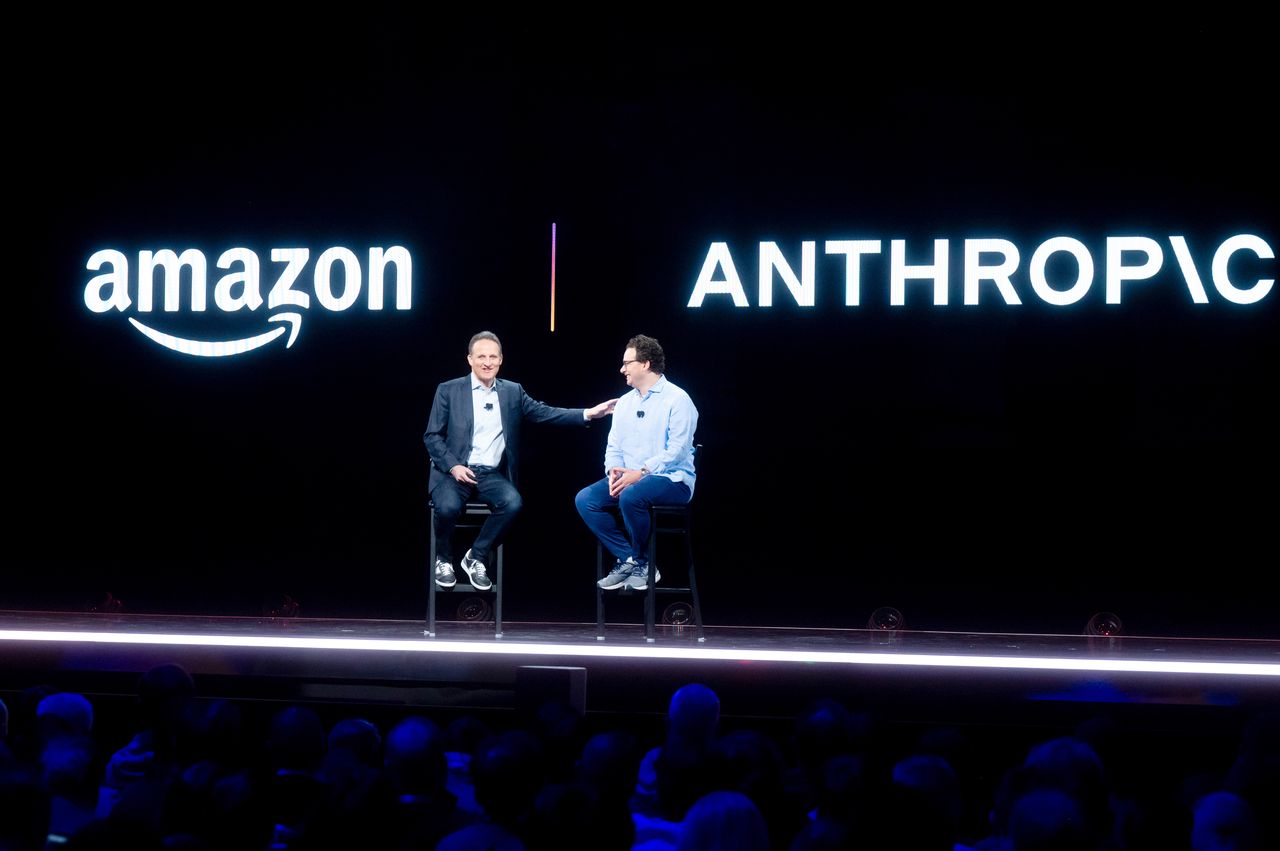
Anthropic Seals $100B Infrastructure Deal With Amazon
Anthropic secured a $100 billion infrastructure commitment from Amazon, expanding the AI vendor's compute capacity for model development and deployment. The deal underscores intensifying competition among cloud providers to lock in generative AI workloads.83