
Earlier stories
Every published Modelwire story, newest first. The homepage leads with the weekly overview and this week’s hottest; this is the full collection.
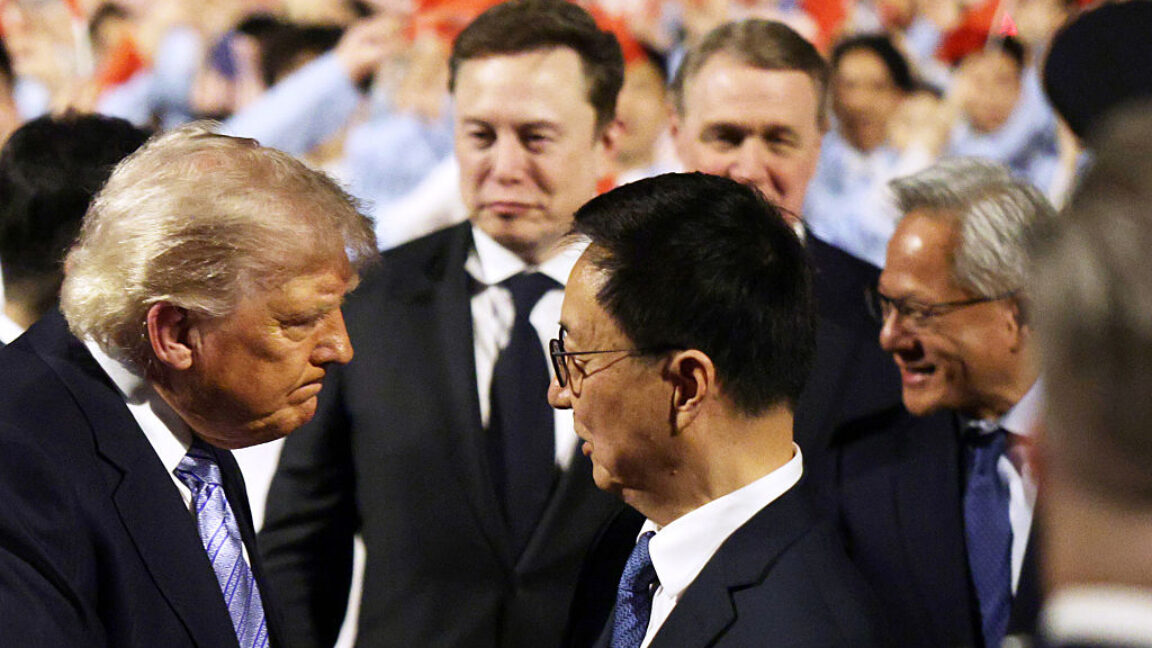
Trump abruptly cancels EO signing event after top AI firm CEOs declined to go
A planned Trump administration AI safety testing executive order has stalled after major AI firm leaders declined to attend its signing ceremony, signaling industry resistance to regulatory friction. The administration subsequently characterized the safety mandate as an innovation impediment, revealing a fundamental tension between the White House's growth-first stance and sector calls for responsible deployment guardrails. This episode exposes how political leverage and corporate participation shape AI governance outcomes, with implications for how safety standards will be negotiated between government and industry going forward.
It's the humans, not the data: Geopolitical bias in LLMs originates in post-training, amplified by the language of the prompt
A multi-lab empirical study reveals that geopolitical bias in LLMs emerges during post-training alignment rather than from base model pretraining data. Testing seven model pairs across 28 country pairs in three languages, researchers found six labs shifted outputs toward their home region after fine-tuning, with Alibaba's Qwen 2.5 showing the most dramatic swing on China favorability. This finding reframes how the field understands bias origins and suggests alignment procedures themselves encode developer geography into model behavior, raising questions about reproducibility and the hidden assumptions baked into instruction-tuning pipelines.68

Hierarchical Concept Geometry in Language Models Emerges from Word Co-occurrence
Researchers have mapped how language models encode hierarchical semantic relationships through a mathematical lens, proving that word embeddings naturally organize concepts from broad to fine-grained categories based on co-occurrence patterns. This work bridges distributional semantics and geometric structure, showing that hypernymy emerges predictably from raw text statistics without explicit supervision. The finding matters for interpretability: it suggests that taxonomic reasoning in neural networks isn't learned through task-specific training but falls out of fundamental statistical properties of language, potentially explaining why LLMs generalize across domains and why probing classifiers can extract structured knowledge from frozen representations.62

SynthID, our imperceptible watermark for AI-generated content, is expanding to more partners.
Google DeepMind's SynthID watermarking technology is gaining traction beyond internal use, now expanding to external partners in a significant move toward industry-standard provenance for AI-generated content. This shift reflects growing pressure to embed authenticity signals directly into model outputs rather than relying on post-hoc detection. The expansion signals that imperceptible watermarking may become table stakes for responsible AI deployment, reshaping how organizations validate synthetic media and potentially influencing regulatory expectations around AI transparency and accountability.
Prompt: AI’s Next Challenge Is Proving the Payoff
The AI industry faces a critical inflection point as enterprises confront the widening gap between deployment costs and measurable returns on massive infrastructure investments. This shift marks a transition from the hype-driven adoption phase to a harder-nosed accountability era where CIOs and CFOs demand concrete ROI metrics before greenlit spending. The pressure signals a potential slowdown in unconstrained AI capex growth and could reshape vendor strategies toward efficiency, vertical-specific solutions, and demonstrable productivity gains rather than raw capability.61

The physics of AI weather models
Researchers have uncovered evidence that neural weather models converge on similar internal representations of atmospheric dynamics despite architectural differences, suggesting they may be learning shared physical principles rather than memorizing patterns. By analyzing forecast skill correlations and kernel alignment across models, the work proposes that AI weather systems implement a particle-based latent description where atmospheric state evolves as gradient flows in learned spaces. This finding reshapes how the field should interpret neural weather model internals and could guide future architecture design by revealing which inductive biases naturally encode physical laws.62

We tried Google’s AI glasses and they’re almost there
Google's Android XR prototype glasses represent a significant shift in how multimodal AI moves from screens into spatial computing. By embedding Gemini directly into eyewear for real-time translation, navigation, and contextual overlays, Google is testing whether LLM-powered assistance can become ambient rather than app-based. This matters because it signals the next battleground for AI deployment: not phones or desktops, but the interface layer closest to human perception. Success here would reshape how users interact with AI daily and lock in Google's position in a hardware-software stack that competitors like Meta and Apple are also racing to own.
LLM-driven design of physics-constrained constitutive models: two agents are better than one
Researchers have moved beyond single-agent LLM pipelines for scientific model generation by introducing a two-agent verification loop for constitutive modeling. A Creator agent proposes material deformation models from data while an Inspector agent validates proposals against nine fundamental physics constraints, rejecting violations for refinement. This addresses a critical gap in autonomous scientific discovery: ensuring that learned models remain physically plausible rather than merely data-fitting. The work signals a broader shift toward multi-agent LLM architectures for high-stakes domains where constraint satisfaction matters more than raw accuracy, with implications for materials science, engineering simulation, and other fields requiring domain-specific guardrails.62

Specialization Beats Scale: A Strategic Variable Most AI Procurement Decisions Overlook
Hugging Face argues that AI procurement strategies have systematically underweighted domain specialization relative to raw model scale, reshaping how enterprises should evaluate deployment decisions. The piece challenges the prevailing assumption that larger foundation models universally outperform smaller, task-optimized alternatives across cost, latency, and accuracy metrics. This reframing matters for procurement teams and infrastructure planners now facing pressure to justify billion-dollar model licensing deals when fine-tuned or specialized alternatives may deliver superior ROI. The insight cuts across model selection, vendor negotiation, and internal resource allocation in enterprise AI stacks.77

Approaching I/O-optimality for Approximate Attention
Researchers have closed a major efficiency gap in transformer attention computation by achieving near-linear I/O complexity in sequence length, a fundamental breakthrough for scaling language models. Previous methods like FlashAttention incurred quadratic memory transfer costs relative to sequence length, but this work leverages approximate attention techniques to reduce I/O to nearly linear scaling across most practical parameter regimes. The advance directly impacts inference and training costs for long-context models, making it strategically relevant for anyone building or deploying LLMs at scale.72

Text Degeneration: A Production Failure Mode That Most Benchmarks Do Not Track
Hugging Face identifies text degeneration as a critical failure mode in large language models that existing benchmarks systematically miss. This work exposes a gap between how models perform on standard evaluations and their real-world behavior, where token-level degradation compounds across generation sequences. The finding matters because it suggests current model rankings and safety assessments may be incomplete, forcing practitioners to rethink deployment confidence and pushing the research community toward more rigorous evaluation frameworks that capture failure modes beyond perplexity and accuracy metrics.84

Even If You Hate AI, You Will Use Google AI Search
Google's integration of AI-generated answers into search represents a structural shift in how information flows online, raising questions about content attribution and creator compensation. The piece argues that convenience will drive adoption regardless of user sentiment toward AI, potentially concentrating traffic away from original sources and creators. This dynamic mirrors broader tensions in the AI ecosystem around training data provenance and the economic viability of content production in an age of synthetic answers.69

The literary world isn’t prepared for AI
A shortlisted entry in the Commonwealth Short Story Prize, a prestigious British literary award, appears to have been AI-generated, exposing a critical gap in institutional vetting processes. The incident signals that creative industries lack reliable detection mechanisms and governance frameworks as generative models become indistinguishable from human work. This raises urgent questions about authentication, attribution, and the need for sector-wide standards before AI-authored submissions become systematically undetectable.
Why would you disrespect your favorite artist with an AI remix?
Spotify's new generative audio tool lowers the barrier to AI-driven music remixing, amplifying a growing problem of low-quality synthetic covers flooding streaming platforms. The move signals how major platforms are monetizing generative capabilities while creators and rights holders face mounting friction from algorithmic content that mimics established artists. This reflects a broader tension in the AI ecosystem: technical enablement outpacing cultural and legal frameworks for attribution and consent in creative domains.
OpenAI burned through $1.22 per dollar earned even after stripping out stock-based compensation
OpenAI's Q1 2026 financials reveal a widening unit economics crisis: the company burned $1.22 for every dollar of revenue despite $5.7 billion in quarterly sales, with adjusted operating margins at minus 122 percent. This signals that even after normalizing for stock compensation, the frontier lab's path to profitability remains severely constrained by inference costs and capital intensity. The gap between revenue scale and operational losses underscores a structural challenge facing the entire LLM industry: whether current pricing models and deployment architectures can ever sustain profitable AI services at scale.85

OpenSkillEval: Automatically Auditing the Open Skill Ecosystem for LLM Agents
OpenSkillEval addresses a critical gap in the LLM agent ecosystem: as structured skills become central to agent performance, there's no standardized way to evaluate skill quality or guide practitioners through cost-performance tradeoffs. This framework automatically audits skills across real-world task categories, moving beyond static benchmarks to test how different models and agent frameworks actually interact with skills in production conditions. For teams building agent systems, this shifts skill selection from guesswork to data-driven evaluation, potentially accelerating adoption of skill-augmented architectures across industry applications.62

Cisco Builds AI Defense with Codex
Cisco deployed OpenAI's Codex to build AI Defense, an enterprise security platform designed to mitigate AI-specific safety and security risks. The shift compressed feature delivery cycles from quarters to weeks, signaling a broader inflection point: large enterprises are now embedding code-generation LLMs into their core development workflows to accelerate AI-native product cycles. This moves beyond proof-of-concept adoption into production infrastructure, reshaping how security tooling itself gets built and iterated.
Less Effort, Shorter Proofs: Reinforcement Learning for Security Protocol Analysis in Tamarin
Researchers have adapted reinforcement learning techniques from AlphaZero and AlphaProof to automate proof search in Tamarin, a formal verification tool for security protocols. The framework uses Monte Carlo Tree Search guided by a learned neural heuristic to reduce manual effort in verifying complex real-world protocols like 5G and WPA2. This represents a meaningful convergence of game-playing AI methods with formal methods, potentially lowering the expertise barrier for protocol security analysis and accelerating detection of vulnerabilities in critical infrastructure.62

California governor signs first US executive order to protect workers from AI job loss
California's executive order marks the first state-level policy intervention targeting AI-driven workforce displacement in the US, signaling a shift toward proactive labor protection as automation accelerates. The move establishes a regulatory precedent that could influence how other states and the federal government approach AI's economic externalities, particularly around retraining, wage protection, and transition support. This reflects growing political pressure to address AI's labor impact before broader national legislation emerges, positioning California as a policy testbed for balancing innovation with worker safeguards.85

Benchmarking Google Embeddings 2 against Open-Source Models for Multilingual Dense Retrieval and RAG Systems
Google's Vertex AI embedding model outperforms five open-source alternatives across multilingual retrieval and RAG tasks, but at a significant latency cost. While Google Embeddings 2 achieves top BEIR scores, the practical tradeoff emerges in deployment: multilingual-E5-large matches its Italian performance within 31ms versus Google's 231ms, reshaping cost-performance calculus for teams with strict latency budgets. This finding signals a maturing market where proprietary cloud embeddings no longer command uncontested superiority, forcing enterprises to weigh accuracy gains against infrastructure lock-in and response-time constraints.62

DiLaDiff: Distilled Latent-Augmented Diffusion for Language Modeling
DiLaDiff addresses a fundamental bottleneck in diffusion language models: the inability to capture token interdependencies forces a painful choice between generation quality and speed. The approach layers three components, a semantic latent space derived from masked diffusion models, a learned prior over that space, and consistency distillation to compress inference into few-step sampling. The result accelerates inference while maintaining or improving output fidelity, potentially reshaping how practitioners balance throughput against coherence in production deployments where diffusion models compete with autoregressive alternatives.62

Trump pulls AI safety order after last-minute calls from Musk, Zuckerberg, and Sacks
A proposed executive order mandating voluntary safety reviews for frontier AI models before deployment has been withdrawn following direct intervention by three major tech figures. The 90-day review framework would have established a structured gate for high-capability systems entering the market. The reversal signals a significant shift in regulatory momentum, reflecting industry pushback against pre-release oversight mechanisms and reshaping expectations around government-led AI governance during this administration.85

Samsung’s memory chip employees negotiated $340,000 bonuses this year
Samsung's semiconductor workforce secured record bonuses averaging $340,000 after threatening an 18-day strike, signaling intensifying competition for chip fabrication talent amid surging AI infrastructure demand. The deal underscores how foundational semiconductor production has become a bottleneck in the AI supply chain, with labor costs rising sharply as chipmakers race to expand capacity for training and inference workloads. This wage pressure ripples across the industry, affecting margins for GPU and accelerator manufacturers while revealing how AI's computational hunger is reshaping labor economics in hardware manufacturing.
Asking For An Old Friend: Diagnosing and Mitigating Temporal Failure Modes in LLM-based Statutory Question Answering
Researchers have identified a critical vulnerability in LLM-based legal systems: models fail when statutory law evolves beyond their training data, either by applying outdated rules or over-weighting recent provisions regardless of temporal relevance. A new benchmark of 312 German statutory QA pairs tests how GPT, Claude, and DeepSeek handle temporal reasoning across vanilla, web-search, and retrieval-augmented inference modes. This work exposes a fundamental mismatch between static parametric knowledge and dynamic legal systems, forcing practitioners to rethink deployment strategies for high-stakes domains where legal accuracy depends on knowing which version of a rule applies to a given fact pattern.62

CoSPlay: Cooperative Self-Play at Test-Time with Self-Generated Code and Unit Test
CoSPlay addresses a critical bottleneck in LLM code generation: the dependency on ground-truth unit tests for training and inference. By enabling models to jointly refine both code and test quality through cooperative self-play without external test data, this framework removes a major constraint on scaling test-time compute for code tasks. The approach matters because it decouples code verification from expensive human-annotated test suites, potentially unlocking broader deployment of verifiable reward signals in production systems where such annotations are unavailable.62

ARES: Automated Rubric Synthesis for Scalable LLM Reinforcement Learning
ARES addresses a critical bottleneck in LLM reinforcement learning: the manual labor required to build rubrics and evaluation datasets for open-ended tasks. By automating the synthesis of question-specific reward rubrics from raw documents, the framework enables instance-level supervision at scale, moving beyond fixed task-level evaluation. This matters because rubric-based RL is one of the few viable paths to train models on subjective, knowledge-intensive problems without human annotation at every step. The approach could reshape how teams approach RLHF workflows and reduce the engineering overhead that currently limits RL adoption beyond benchmark tasks.62

Google I/O showed how the path for AI-driven science is shifting
Google DeepMind's leadership used Google I/O to signal a strategic pivot toward AI-driven scientific discovery, with Demis Hassabis framing the moment as a threshold toward transformative capability gains. The keynote reflects a broader industry shift where frontier labs are repositioning from consumer applications toward research infrastructure and domain-specific breakthroughs. This signals how major players are now competing on scientific credibility and long-term capability trajectories rather than incremental product features, reshaping investor and researcher expectations around AI's near-term value.
The Gulf’s AI Boom Has an Undersea Cable Problem
Gulf region hyperscalers face a critical infrastructure bottleneck as undersea cable capacity becomes the limiting factor for AI deployment at scale. Rising computational demand from large language models and training clusters has exposed fragility in regional connectivity, forcing a reckoning with internet backbone resilience. Cable cuts or congestion now pose direct threats to AI service continuity, making infrastructure redundancy a competitive necessity rather than an operational luxury for cloud providers betting on the region.69

Metacognition as Reward: Reinforcing LLM Reasoning via Knowledge and Regulation Signals
Researchers propose Metacognition-as-Reward, a reinforcement learning framework that moves beyond binary outcome signals and rubric-based scoring to guide LLM reasoning through two process dimensions: metacognitive knowledge and metacognitive regulation. The approach addresses a critical gap in current RL methods, which either provide sparse feedback on intermediate steps or demand labor-intensive, task-specific rubric design. By treating the model's own reasoning process as a reward signal, MaR offers a more generalizable path to improving reasoning quality across diverse tasks without per-instance customization. This matters for practitioners scaling RL-based reasoning systems, as it potentially reduces the engineering overhead while maintaining fine-grained guidance on how models should think, not just what they should output.62