
Google DeepMind (YouTube)
https://www.youtube.com/@GoogleDeepMind · Editorial weight 7/10
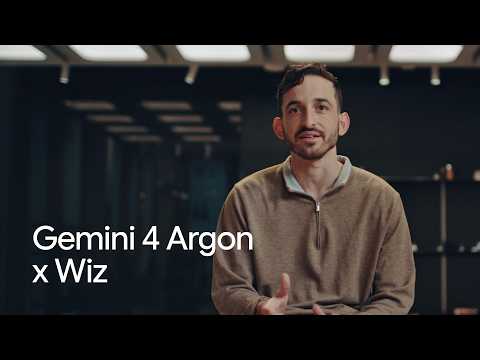
Gemini 4 Argon doubles vulnerability detection in security testing
Google DeepMind's Gemini 4 Argon demonstrates a meaningful capability leap in AI-assisted security operations. In controlled testing with Wiz researchers, the model identified twice as many vulnerabilities as baseline systems, including critical flaws like authentication bypasses in healthcare infrastructure. The result signals a shift in how frontier LLMs can augment defensive security workflows through multi-step reasoning and sustained threat analysis. For enterprise security teams, this raises both opportunity and urgency: AI-native threat detection is moving from research to operational advantage, reshaping the competitive surface between defenders and attackers.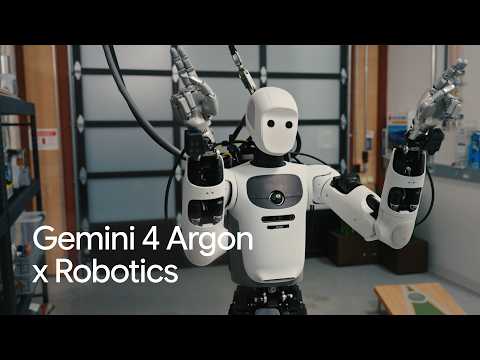
Gemini 4 Argon bridges video to robot control via physics simulation
Google DeepMind demonstrated a practical pipeline for teaching humanoid robots physical tasks by having Gemini 4 Argon analyze human video, generate physics simulations in MuJoCo, and transfer learned control to Apptronik's Apollo 2 robot. The system achieved seven consecutive cornhole shots in the real world, compressing weeks of manual engineering into hours. This video-to-simulation-to-reality workflow signals a shift toward using multimodal LLMs as bridges between human demonstration and robotic execution, potentially accelerating physical AI development beyond hand-coded environments.
Isomorphic Labs cuts chemistry patent review from months to days with Gemini 4
Isomorphic Labs is deploying Gemini 4 Argon to compress months of chemistry patent review into single afternoons by extracting structured insights from dense multimodal documents. This application signals a shift in how frontier models tackle domain-specific knowledge work: rather than replacing domain experts, they're collapsing the time cost of literature synthesis, freeing researchers to focus on hypothesis generation and experimental design. The move validates multimodal reasoning as a practical lever for knowledge-intensive industries where information fragmentation across long documents remains a bottleneck.
DeepMind extends AI watermarking into protein design with SynthID Bio
DeepMind has extended SynthID, its AI watermarking framework, into biological domains, enabling invisible mathematical signatures on protein sequences without compromising function. The expansion moves provenance tracking beyond text and images into synthetic biology, addressing a critical gap as AI-designed molecules enter research and development pipelines. This development matters because it establishes a technical standard for tracing AI-generated biological assets, reducing misuse risk in a field where attribution and safety verification remain nascent concerns.
Google DeepMind launches voice cloning and synthesis with built-in consent verification
Google DeepMind's Gemini 3.8 text-to-speech model expands generative audio capabilities by enabling both synthetic voice creation from natural language prompts and voice cloning from 30-second samples. The release introduces line-by-line performance direction with acting cues and dialect control, alongside consent verification and SynthID watermarking to address synthetic media authenticity concerns. This positions Google to compete directly in the creator economy and enterprise audio space while establishing technical standards for voice provenance that could influence industry norms around synthetic talent rights.
DeepMind's WeatherNext 3 pairs neural networks with physics for hurricane forecasting
Google DeepMind's WeatherNext 3 represents a meaningful shift in how machine learning augments classical physics-based forecasting rather than replacing it. The model demonstrates concrete utility in high-stakes scenarios, from hurricane prediction to renewable energy planning, addressing a domain where traditional numerical weather prediction has fundamental limits. This work signals growing confidence in hybrid AI approaches for complex physical systems, where neural networks learn patterns that classical solvers struggle with. For the AI infrastructure landscape, weather forecasting serves as a proving ground for models that must generalize across spatial and temporal scales while maintaining physical plausibility, a constraint less common in language or vision tasks.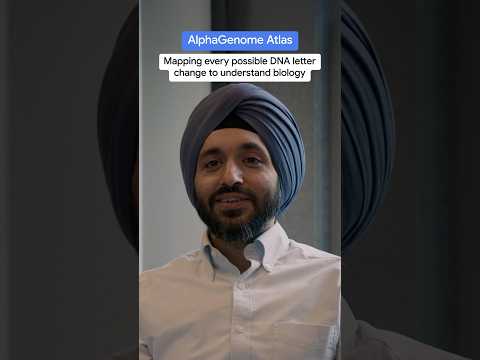
DeepMind releases AlphaGenome Atlas for variant effect prediction
DeepMind's AlphaGenome Atlas represents a significant shift in genomic medicine: applying deep learning to map the functional consequences of all possible DNA variants at scale. Rather than sequencing individual genomes and hoping to spot disease-causing mutations, researchers now have a predictive foundation to interrogate rare genetic disorders systematically. This infrastructure move mirrors how foundation models have reshaped other domains, turning a brute-force search problem into a learned inference task. Early adoption for rare disease diagnosis and complex trait mapping signals that AI-driven variant interpretation is moving from research curiosity to clinical workflow, with implications for precision medicine adoption and the competitive landscape around genomic AI tools.
Google DeepMind shifts weather forecasting to learned models with hourly updates
Google DeepMind's WeatherNext 3 represents a strategic shift in weather forecasting away from traditional numerical models toward learned systems trained on satellite and ground-station data. The system achieves hourly forecast updates versus the industry standard six-hour cycle, and delivers 5km resolution predictions for temperature and humidity. This advancement matters because it demonstrates how deep learning can compress computational overhead while improving temporal granularity and spatial specificity, a pattern increasingly relevant across scientific simulation domains. The move signals DeepMind's continued focus on applying neural networks to complex physical systems where traditional methods face scalability constraints.
DeepMind researcher positions uncertainty quantification as missing AI foundation
Zoubin Ghahramani, now VP of research at Google DeepMind, argues that quantifying machine uncertainty may be foundational to advancing AI beyond current scaling limits. His three-decade focus on Bayesian methods addresses a critical gap: models that know what they don't know. The video explores how confidence calibration differs from correctness, historical uncertainty frameworks, and real-world deployment challenges. For practitioners, this signals DeepMind's research direction toward more robust, interpretable systems rather than raw capability gains alone.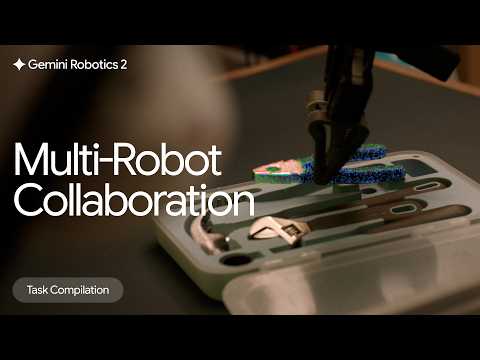
Google DeepMind enables multi-robot collaboration with Gemini Robotics 2
Google DeepMind has advanced multi-robot coordination with Gemini Robotics 2, enabling heterogeneous robot teams to communicate and collaborate on tasks beyond individual capability. This represents a shift from single-agent automation toward distributed problem-solving in physical systems, expanding the practical scope of embodied AI. The capability to orchestrate diverse robot types signals growing maturity in real-world AI deployment and raises questions about coordination complexity, safety protocols, and industrial adoption timelines for collaborative robotic workflows.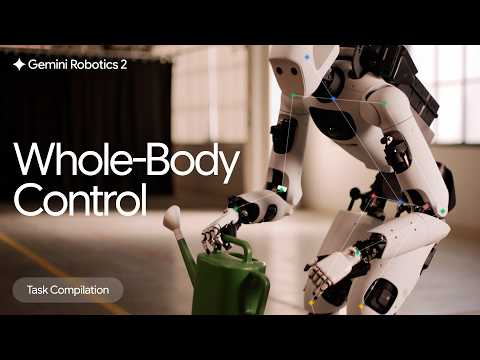
Google DeepMind expands robot control from upper-body to full-body coordination
Google DeepMind's Gemini Robotics 2 marks a significant expansion in embodied AI, moving beyond isolated upper-body manipulation to coordinate full-body locomotion and balance in unstructured environments. This progression addresses a core challenge in robotics: navigating spaces designed for human morphology requires integrated control across multiple limbs and dynamic stability. The shift from tabletop tasks to whole-body coordination represents a necessary step toward general-purpose physical agents capable of real-world deployment, directly impacting how roboticists approach multi-task learning and embodied reasoning.
Google DeepMind advances robot dexterity with Gemini Robotics 2
Google DeepMind's Gemini Robotics 2 represents a meaningful step toward practical robot deployment by advancing physical dexterity across diverse end effectors. The system's ability to handle fine-grained manipulation tasks with both hands and grippers signals progress in bridging the gap between lab demonstrations and real-world utility in homes and workplaces. This capability leap matters because dexterity has long been a bottleneck in robotics adoption; robots that can reliably perform intricate tasks unlock new applications in service industries and manufacturing, reshaping where autonomous systems become economically viable.
Google DeepMind reconstructs lost Pelé goal using Gemini and Veo
Google DeepMind deployed generative video and multimodal models to reconstruct a historically significant but unfilmed soccer moment, partnering with the Pelé estate to recreate the 1959 'Gol da Rua Javari' using Gemini Omni and Veo. The project signals a shift in how frontier AI labs position synthetic media capabilities: not as entertainment or marketing gimmicks, but as tools for cultural preservation and historical documentation. By anchoring the work in archival research and museum placement, DeepMind frames generative video as infrastructure for memory recovery rather than content creation, setting a precedent for how AI vendors might justify synthetic media to skeptical institutions and regulators.
DeepMind explores neural network interpretability as safety prerequisite
DeepMind's latest interpretability work, featuring researcher Neel Nanda, tackles a foundational challenge in AI safety: reverse-engineering neural network decision-making before systems reach AGI scale. The episode surfaces concrete discoveries like sparse autoencoders that reveal elegant internal structures within black-box models, while acknowledging hard limits to what introspection can reveal. For builders and safety teams, this frames interpretability not as academic curiosity but as a prerequisite for trustworthy deployment. As model capabilities accelerate, the gap between what we build and what we understand widens, making this research critical infrastructure for the alignment roadmap.
When millions of AI agents meet
Google DeepMind is advancing the conceptual framework for an 'agentic economy' where millions of autonomous AI agents negotiate, transact, and delegate tasks among themselves rather than simply responding to human prompts. The shift from isolated language models to cooperative multi-agent systems introduces novel operational challenges: automation bias risks, dynamic security threats like agentic traps and cloaking, and the need for distributed coordination protocols. This represents a fundamental architectural transition in how AI systems will be deployed at scale, moving beyond single-model inference toward emergent agent societies that require new governance and security models.
Gemini for Science is here. 🧬
Google DeepMind has launched Gemini for Science, a specialized variant of its flagship model designed to accelerate research workflows across biology, chemistry, and physics. This release signals a strategic pivot toward domain-specific AI applications that combine reasoning depth with scientific accuracy, positioning Gemini as a competitor to Claude and GPT-4 in the high-stakes research market. The move reflects growing recognition that general-purpose LLMs require fine-tuning and safety constraints to be credible in domains where errors carry material consequences. For research institutions and biotech firms, this opens a new pathway to integrate frontier AI into discovery pipelines, though adoption will hinge on validation against peer-reviewed benchmarks.
SynthID, our imperceptible watermark for AI-generated content, is expanding to more partners.
Google DeepMind's SynthID watermarking technology is gaining traction beyond internal use, now expanding to external partners in a significant move toward industry-standard provenance for AI-generated content. This shift reflects growing pressure to embed authenticity signals directly into model outputs rather than relying on post-hoc detection. The expansion signals that imperceptible watermarking may become table stakes for responsible AI deployment, reshaping how organizations validate synthetic media and potentially influencing regulatory expectations around AI transparency and accountability.
Gemini 3.5 Flash has landed.
Google DeepMind has released Gemini 3.5 Flash, signaling continued iteration on its flagship model line and competitive pressure in the fast-moving frontier-model space. Flash variants typically prioritize speed and cost efficiency over raw capability, positioning this release as a play for developer adoption and production workloads where latency matters. The timing and naming suggest Google is maintaining cadence against rivals while refining its model portfolio across performance tiers. For practitioners, this likely expands accessible inference options within the Gemini ecosystem.
Generating novel scientific hypotheses with Co-Scientist
Google DeepMind has released Co-Scientist, a multi-agent Gemini system designed to accelerate scientific discovery by autonomously generating, critiquing, and refining research hypotheses. The system addresses a critical bottleneck in modern science: transforming raw information into actionable experimental directions. This represents a meaningful shift in how AI augments the research process, moving beyond literature retrieval into active hypothesis generation and debate. The work, published in Nature, signals that frontier labs now view AI as capable of participating in the earliest, most creative stages of scientific inquiry, not merely executing predetermined experiments.
Using AI to outsmart drug-resistant bacteria
DeepMind researchers at Cambridge are collapsing years of drug discovery into minutes by pairing structural biology with AlphaFold and Gemini to reverse-engineer bacterial resistance mechanisms. The work signals a strategic shift in how AI tackles antimicrobial resistance, a public health crisis where traditional antibiotic development has stalled. By automating the identification of hidden bacterial defenses, the team demonstrates AI's capacity to compress iterative scientific workflows into tractable timescales, potentially reshaping how biotech approaches pathogen evolution.
Understanding cancer at a genetic level with AI
DeepMind's computational biology toolkit is enabling resource-constrained research institutions to tackle oncology at scale. Makerere University's team leveraged AlphaFold and AlphaGenome to screen 15,000 protein binding sites for early-onset breast cancer vaccine targets in Uganda, reducing the search space to 15 candidates for wet-lab validation using only commodity hardware. This case study signals a shift in how AI infrastructure democratizes biomedical discovery across the Global South, where disease burden is highest but computational access has historically been limited. The work underscores DeepMind's pivot toward applied impact and suggests that foundation models for biology are maturing beyond research papers into operational tools for clinical translation.
Predicting a historic storm earlier with WeatherNext
Google DeepMind's WeatherNext model demonstrated measurable real-world impact by forecasting Hurricane Melissa's intensity and track days in advance, enabling authorities to issue timely evacuation orders in Jamaica. The deployment marks a shift in how specialized AI systems move from research into operational meteorology, with DeepMind now collaborating directly with the National Hurricane Center to integrate neural forecasting into institutional decision-making. This represents a concrete case study in domain-specific model deployment where prediction accuracy directly translates to life-safety outcomes, signaling growing institutional confidence in AI-driven weather systems for high-stakes applications.