
Earlier stories
Every published Modelwire story, newest first. The homepage leads with the weekly overview and this week’s hottest; this is the full collection.

How VCs and founders use inflated ‘ARR’ to crown AI startups
AI startups and their backers are gaming revenue metrics by inflating Annual Recurring Revenue (ARR) figures to project outsized growth trajectories. This practice signals a widening credibility gap in how the sector measures progress, particularly as venture capital chases AI exits before fundamentals stabilize. The trend exposes structural incentives that reward narrative over substance, forcing downstream investors and acquirers to recalibrate due diligence and raising questions about which AI companies will survive the next funding correction.
Create and edit presentations faster in PowerPoint
OpenAI has embedded ChatGPT directly into Microsoft PowerPoint, allowing users to draft, structure, and refine presentations without leaving the application. The integration accepts external files and context, automating the conversion of source material into slide decks while enabling inline editing. Now in beta across all customer tiers, this represents a significant expansion of LLM utility into enterprise productivity workflows, signaling OpenAI's strategy to embed AI agents deeper into existing tools rather than compete as standalone applications.
Cloudflare CEO Prince says builders and sellers are safe but AI is coming for the measurers
Cloudflare's 20 percent workforce reduction exposes a widening gap between AI hype and operational reality in enterprise tech. CEO Matthew Prince framed the cuts as AI displacement of middle management and compliance functions, yet the company provided no evidence linking automation to the layoffs. The timing is revealing: headcount grew 40 percent over two years while margins compressed, suggesting the efficiency narrative masks a classic correction cycle. This pattern matters for the AI industry because it signals how readily executives invoke AI as cover for structural cost-cutting, potentially masking whether genuine automation is actually driving labor displacement or whether companies simply overexpanded and are now recalibrating.68

SkillOpt: Executive Strategy for Self-Evolving Agent Skills
SkillOpt introduces a principled optimization framework for agent skills, treating them as learnable external parameters rather than hand-crafted or loosely revised artifacts. By applying weight-space optimization discipline to text-space skill evolution, the system uses a separate optimizer model to generate bounded edits validated against held-out performance metrics. This addresses a fundamental gap in agent development: reproducible, controllable skill improvement under feedback. The approach matters because it bridges the gap between deep learning's rigorous optimization practices and the ad-hoc skill engineering that currently dominates agentic systems, potentially unlocking more reliable scaling of agent capabilities.62

LLMs as Noisy Channels: A Shannon Perspective on Model Capacity and Scaling Laws
Researchers propose a Shannon-theoretic framework for LLM scaling that reinterprets model training as noisy-channel communication, offering a unified explanation for non-monotonic performance phenomena like catastrophic overtraining and quantization collapse. This perspective maps model parameters to channel bandwidth and training tokens to signal power, suggesting a fundamental capacity ceiling where scaling without maintaining signal-to-noise ratio yields diminishing or negative returns. The work challenges conventional power-law scaling assumptions and could reshape how practitioners think about compute allocation, data quality, and model size trade-offs in production systems.62

Complete-muE: Optimal Hyperparameter Transfer and Scaling for MoE Models
Complete-muE addresses a critical scaling bottleneck in mixture-of-experts architectures by enabling hyperparameter transfer across dense and sparse MoE configurations. Prior methods like μP and SDE fail when model topology or token distribution shifts, forcing practitioners to retune from scratch at each scale. This framework's two-bridge approach decouples architecture changes from optimization dynamics, allowing transfer rules to propagate across orders-of-magnitude scaling. For teams training large MoE models, this cuts experimentation cycles and reduces compute waste during architecture exploration, directly impacting training efficiency at scale.62

OpenAI launches a ChatGPT Powerpoint plugin and warns it might accidentally delete your content
OpenAI's ChatGPT integration into Microsoft PowerPoint marks a significant expansion of LLM utility into enterprise productivity workflows. The plugin automates slide generation from unstructured inputs and enables real-time editing, lowering barriers to presentation creation across all subscription tiers. However, the explicit warning about potential accidental content deletion signals that AI-assisted document manipulation remains a reliability concern in production environments, raising questions about safety guardrails in high-stakes business tools where data loss carries real cost.73

Training-Free Looped Transformers
Researchers have developed a method to add recurrent loops to frozen transformer checkpoints without retraining, treating layer reapplication as refinement steps in an ODE approximation rather than naive repetition. This inference-time retrofit technique sidesteps the computational cost of end-to-end looped training while maintaining or improving performance across dense, sparse MoE, and MLA+MoE architectures. The approach matters because it unlocks a cheap path to deeper reasoning or longer context from existing models, potentially shifting how practitioners optimize inference efficiency without model retraining.62

Deepseek reportedly prioritizes AGI research over quick profits despite billions in funding
Deepseek's $10 billion funding round at a $45 billion valuation signals a strategic pivot within China's AI hierarchy. Founder Liang Wenfeng is explicitly subordinating near-term monetization to AGI research, a posture that contrasts sharply with the venture-capital-driven timelines dominating Western labs. This move reshapes competitive dynamics: a well-capitalized Chinese player betting on long-horizon capability gains rather than product velocity could accelerate the global race while testing whether patient capital can outpace quarterly-earnings pressure in frontier AI development.85

Strong Teacher Not Needed? On Distillation in LLM Pretraining
Researchers challenge a foundational assumption in knowledge distillation: that stronger teachers always produce better student models. By systematically varying teacher and student architectures and training budgets, they demonstrate that weaker teachers can meaningfully improve larger models when loss functions are properly balanced, while over-training teachers can plateau or degrade performance gains. This finding reshapes how practitioners should allocate compute during pretraining, suggesting efficiency gains are possible by decoupling teacher quality from distillation effectiveness.62

OpenAI Appshots turn any Mac window into context for Codex
OpenAI's Appshots feature extends Codex's utility by allowing Mac users to capture any application window as direct context for coding tasks. This workflow innovation reduces friction in the developer loop, letting engineers feed visual UI state, error messages, or design mockups directly into the assistant without manual transcription. The move signals OpenAI's focus on embedding Codex deeper into native development environments, competing with IDE-native tools and positioning LLM-assisted coding as a contextual, not just textual, capability.68

Personal Finance in ChatGPT
OpenAI is moving ChatGPT into financial services by letting Pro subscribers connect bank accounts and query spending patterns directly within the interface. This marks a strategic pivot toward vertical integration of LLMs into high-stakes personal data domains, positioning conversational AI as a gateway to regulated financial workflows. The phased rollout signals OpenAI's caution around compliance and trust, but success here would establish a template for embedding LLMs into other sensitive verticals like healthcare and legal services where context-aware reasoning commands premium pricing.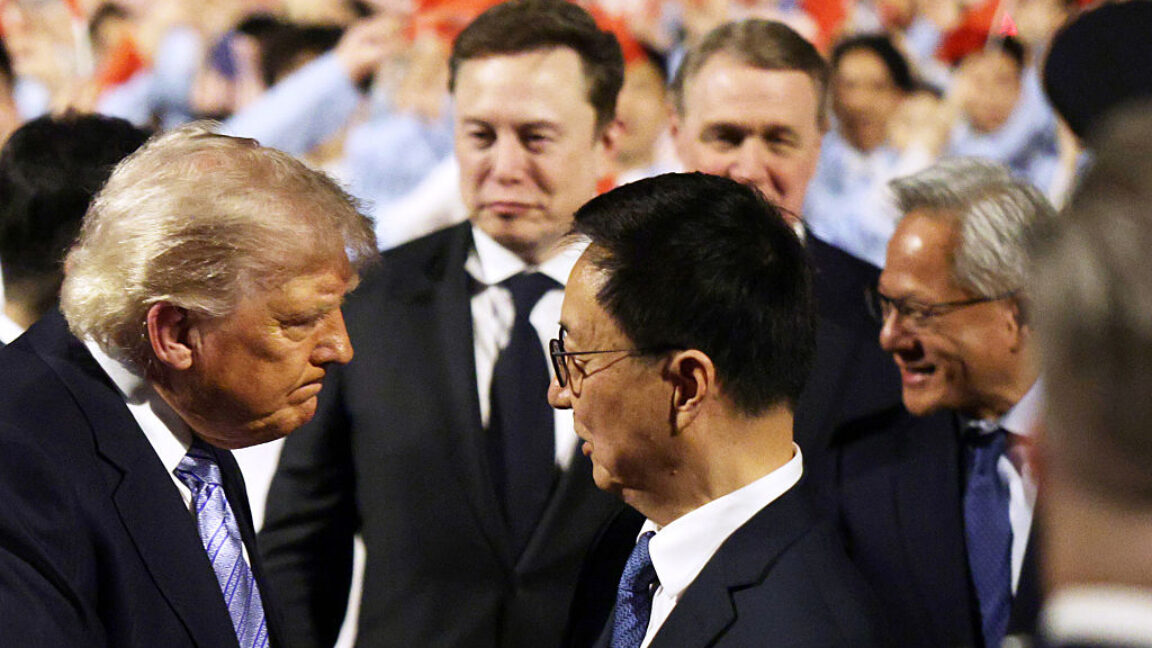
Trump abruptly cancels EO signing event after top AI firm CEOs declined to go
A planned Trump administration AI safety testing executive order has stalled after major AI firm leaders declined to attend its signing ceremony, signaling industry resistance to regulatory friction. The administration subsequently characterized the safety mandate as an innovation impediment, revealing a fundamental tension between the White House's growth-first stance and sector calls for responsible deployment guardrails. This episode exposes how political leverage and corporate participation shape AI governance outcomes, with implications for how safety standards will be negotiated between government and industry going forward.
It's the humans, not the data: Geopolitical bias in LLMs originates in post-training, amplified by the language of the prompt
A multi-lab empirical study reveals that geopolitical bias in LLMs emerges during post-training alignment rather than from base model pretraining data. Testing seven model pairs across 28 country pairs in three languages, researchers found six labs shifted outputs toward their home region after fine-tuning, with Alibaba's Qwen 2.5 showing the most dramatic swing on China favorability. This finding reframes how the field understands bias origins and suggests alignment procedures themselves encode developer geography into model behavior, raising questions about reproducibility and the hidden assumptions baked into instruction-tuning pipelines.68

Hierarchical Concept Geometry in Language Models Emerges from Word Co-occurrence
Researchers have mapped how language models encode hierarchical semantic relationships through a mathematical lens, proving that word embeddings naturally organize concepts from broad to fine-grained categories based on co-occurrence patterns. This work bridges distributional semantics and geometric structure, showing that hypernymy emerges predictably from raw text statistics without explicit supervision. The finding matters for interpretability: it suggests that taxonomic reasoning in neural networks isn't learned through task-specific training but falls out of fundamental statistical properties of language, potentially explaining why LLMs generalize across domains and why probing classifiers can extract structured knowledge from frozen representations.62

SynthID, our imperceptible watermark for AI-generated content, is expanding to more partners.
Google DeepMind's SynthID watermarking technology is gaining traction beyond internal use, now expanding to external partners in a significant move toward industry-standard provenance for AI-generated content. This shift reflects growing pressure to embed authenticity signals directly into model outputs rather than relying on post-hoc detection. The expansion signals that imperceptible watermarking may become table stakes for responsible AI deployment, reshaping how organizations validate synthetic media and potentially influencing regulatory expectations around AI transparency and accountability.
Prompt: AI’s Next Challenge Is Proving the Payoff
The AI industry faces a critical inflection point as enterprises confront the widening gap between deployment costs and measurable returns on massive infrastructure investments. This shift marks a transition from the hype-driven adoption phase to a harder-nosed accountability era where CIOs and CFOs demand concrete ROI metrics before greenlit spending. The pressure signals a potential slowdown in unconstrained AI capex growth and could reshape vendor strategies toward efficiency, vertical-specific solutions, and demonstrable productivity gains rather than raw capability.61

The physics of AI weather models
Researchers have uncovered evidence that neural weather models converge on similar internal representations of atmospheric dynamics despite architectural differences, suggesting they may be learning shared physical principles rather than memorizing patterns. By analyzing forecast skill correlations and kernel alignment across models, the work proposes that AI weather systems implement a particle-based latent description where atmospheric state evolves as gradient flows in learned spaces. This finding reshapes how the field should interpret neural weather model internals and could guide future architecture design by revealing which inductive biases naturally encode physical laws.62

We tried Google’s AI glasses and they’re almost there
Google's Android XR prototype glasses represent a significant shift in how multimodal AI moves from screens into spatial computing. By embedding Gemini directly into eyewear for real-time translation, navigation, and contextual overlays, Google is testing whether LLM-powered assistance can become ambient rather than app-based. This matters because it signals the next battleground for AI deployment: not phones or desktops, but the interface layer closest to human perception. Success here would reshape how users interact with AI daily and lock in Google's position in a hardware-software stack that competitors like Meta and Apple are also racing to own.
LLM-driven design of physics-constrained constitutive models: two agents are better than one
Researchers have moved beyond single-agent LLM pipelines for scientific model generation by introducing a two-agent verification loop for constitutive modeling. A Creator agent proposes material deformation models from data while an Inspector agent validates proposals against nine fundamental physics constraints, rejecting violations for refinement. This addresses a critical gap in autonomous scientific discovery: ensuring that learned models remain physically plausible rather than merely data-fitting. The work signals a broader shift toward multi-agent LLM architectures for high-stakes domains where constraint satisfaction matters more than raw accuracy, with implications for materials science, engineering simulation, and other fields requiring domain-specific guardrails.62

Specialization Beats Scale: A Strategic Variable Most AI Procurement Decisions Overlook
Hugging Face argues that AI procurement strategies have systematically underweighted domain specialization relative to raw model scale, reshaping how enterprises should evaluate deployment decisions. The piece challenges the prevailing assumption that larger foundation models universally outperform smaller, task-optimized alternatives across cost, latency, and accuracy metrics. This reframing matters for procurement teams and infrastructure planners now facing pressure to justify billion-dollar model licensing deals when fine-tuned or specialized alternatives may deliver superior ROI. The insight cuts across model selection, vendor negotiation, and internal resource allocation in enterprise AI stacks.77

Approaching I/O-optimality for Approximate Attention
Researchers have closed a major efficiency gap in transformer attention computation by achieving near-linear I/O complexity in sequence length, a fundamental breakthrough for scaling language models. Previous methods like FlashAttention incurred quadratic memory transfer costs relative to sequence length, but this work leverages approximate attention techniques to reduce I/O to nearly linear scaling across most practical parameter regimes. The advance directly impacts inference and training costs for long-context models, making it strategically relevant for anyone building or deploying LLMs at scale.72

Text Degeneration: A Production Failure Mode That Most Benchmarks Do Not Track
Hugging Face identifies text degeneration as a critical failure mode in large language models that existing benchmarks systematically miss. This work exposes a gap between how models perform on standard evaluations and their real-world behavior, where token-level degradation compounds across generation sequences. The finding matters because it suggests current model rankings and safety assessments may be incomplete, forcing practitioners to rethink deployment confidence and pushing the research community toward more rigorous evaluation frameworks that capture failure modes beyond perplexity and accuracy metrics.84

Even If You Hate AI, You Will Use Google AI Search
Google's integration of AI-generated answers into search represents a structural shift in how information flows online, raising questions about content attribution and creator compensation. The piece argues that convenience will drive adoption regardless of user sentiment toward AI, potentially concentrating traffic away from original sources and creators. This dynamic mirrors broader tensions in the AI ecosystem around training data provenance and the economic viability of content production in an age of synthetic answers.69

The literary world isn’t prepared for AI
A shortlisted entry in the Commonwealth Short Story Prize, a prestigious British literary award, appears to have been AI-generated, exposing a critical gap in institutional vetting processes. The incident signals that creative industries lack reliable detection mechanisms and governance frameworks as generative models become indistinguishable from human work. This raises urgent questions about authentication, attribution, and the need for sector-wide standards before AI-authored submissions become systematically undetectable.
Why would you disrespect your favorite artist with an AI remix?
Spotify's new generative audio tool lowers the barrier to AI-driven music remixing, amplifying a growing problem of low-quality synthetic covers flooding streaming platforms. The move signals how major platforms are monetizing generative capabilities while creators and rights holders face mounting friction from algorithmic content that mimics established artists. This reflects a broader tension in the AI ecosystem: technical enablement outpacing cultural and legal frameworks for attribution and consent in creative domains.OpenAI burned through $1.22 per dollar earned even after stripping out stock-based compensation
OpenAI's Q1 2026 financials reveal a widening unit economics crisis: the company burned $1.22 for every dollar of revenue despite $5.7 billion in quarterly sales, with adjusted operating margins at minus 122 percent. This signals that even after normalizing for stock compensation, the frontier lab's path to profitability remains severely constrained by inference costs and capital intensity. The gap between revenue scale and operational losses underscores a structural challenge facing the entire LLM industry: whether current pricing models and deployment architectures can ever sustain profitable AI services at scale.85

OpenSkillEval: Automatically Auditing the Open Skill Ecosystem for LLM Agents
OpenSkillEval addresses a critical gap in the LLM agent ecosystem: as structured skills become central to agent performance, there's no standardized way to evaluate skill quality or guide practitioners through cost-performance tradeoffs. This framework automatically audits skills across real-world task categories, moving beyond static benchmarks to test how different models and agent frameworks actually interact with skills in production conditions. For teams building agent systems, this shifts skill selection from guesswork to data-driven evaluation, potentially accelerating adoption of skill-augmented architectures across industry applications.62
