
Earlier stories
Every published Modelwire story, newest first. The homepage leads with the weekly overview and this week’s hottest; this is the full collection.

Image Line upgrades FL Studio's AI assistant from chatbot to active engineer
Image Line's evolution of Gopher from a static knowledge retriever into an active production assistant marks a shift in how DAWs integrate AI reasoning into creative workflows. Rather than passively answering questions, the upgraded chatbot now participates in real-time mixing and sound design decisions, positioning specialized music software as a testing ground for agentic AI in domain-specific contexts. This matters because it demonstrates how LLMs can move beyond chat interfaces into tools where domain expertise and user intent alignment directly impact output quality, a pattern likely to spread across professional creative software.
Ollama secures $65M as local AI inference gains mainstream developer traction
Ollama's $65M Series B positions the open-source runtime as a critical bridge between consumer hardware and local AI inference. With 9M users and strong Github adoption, the Benchmark-backed startup has validated a market thesis: developers want accessible alternatives to cloud-dependent AI workflows. This funding round signals investor confidence in the decentralization trend, where running capable models on personal machines becomes standard practice rather than niche. For the broader ecosystem, Ollama's growth underscores demand for tooling that democratizes AI development beyond enterprise cloud platforms.
Character.ai shifts from chatbot platform to content producer with interactive shows
Character.ai is leveraging its conversational AI infrastructure to produce original scripted content, then monetizing engagement through interactive character chat. This represents a vertical integration play where the platform transforms from a tool into a content studio, using its LLM backbone to generate both narrative and dynamic user interactions. The model suggests how consumer AI companies can move beyond utility into entertainment, creating stickier products by blending passive consumption with active roleplay. For the broader landscape, this signals how character-driven LLMs are becoming distribution channels for media, not just chatbots.
GPT-5.6 becomes default engine for Microsoft 365 Copilot
OpenAI's GPT-5.6 integration into Microsoft 365 Copilot signals a deepening partnership between the two tech giants and reflects the ongoing race to embed frontier models into enterprise productivity workflows. The upgrade targets knowledge workers across Word, Excel, PowerPoint, and collaboration tools, suggesting OpenAI is prioritizing real-world utility over raw benchmark gains. This move consolidates Microsoft's AI strategy around a single model family, reducing fragmentation and potentially locking in competitive advantage in the $100B+ enterprise software market. For practitioners, it means GPT-5.6 capabilities are now accessible to millions of Office users without separate API calls or tool switching.94

Reinforcement learning closes synthetic speech gap for regulated ASR
Researchers demonstrate that reinforcement learning substantially outperforms supervised fine-tuning when adapting speech recognition models to regulated domains where real audio is scarce or legally restricted. Using Group Relative Policy Optimization, a critic-free RL method, teams achieved 40% relative WER reduction over SFT baselines on synthetic speech alone, with combined approaches reaching 45% improvement. The finding matters because it unlocks a practical path for deploying LLM-based ASR in privacy-sensitive sectors like banking without expensive data collection, shifting the bottleneck from data scarcity to training methodology.62

Researchers compress prompts into single activation vectors for faster inference
Researchers have demonstrated that task-specific information embedded in instruction prompts can be distilled into a single activation vector, then reinjected into an LLM at an earlier layer, bypassing the need to reprocess the original token sequence. The technique achieves under 2% accuracy loss while enabling significant computational savings on repeated queries with fixed instructions. This work has immediate practical implications for inference efficiency in production systems, particularly for applications relying on stable system prompts, and offers new insights into how LLMs encode and propagate instruction semantics across layers.62

Runtime defense framework targets semantic attacks in persistent AI agents
As AI agents move beyond single-turn chatbots into persistent, long-lived systems with memory and tool access, a new attack surface emerges: semantic flows through natural language tokens that can corrupt state and propagate harm across components. Researchers propose TokenWall, a runtime defense framework that intercepts risky semantic patterns before they reach privileged operations. This work addresses a critical gap in agent security as production deployments increasingly rely on multi-step reasoning and persistent context, making traditional input/output filtering insufficient for systems where internal token flows carry execution risk.62

Fine-tuned LLMs memorize facts but fail to reason with them
Researchers have identified a fundamental bottleneck in LLM fine-tuning: models can absorb new facts rapidly but fail to apply them in reasoning tasks. This 'Knowing-Using Gap' reveals that memorized knowledge doesn't automatically route through the circuits needed for downstream inference. Using a technique called self-patching to trace internal activation patterns, the work suggests memorized representations exist in isolation rather than integrating with existing reasoning pathways. This finding has direct implications for practitioners building domain-specific LLMs and raises questions about whether current fine-tuning approaches fundamentally misalign knowledge storage with knowledge application.62

Specialized generative models emerge to tackle tabular data where LLMs falter
A structural weakness in foundation models is becoming clear: despite their language prowess, LLMs fundamentally struggle with tabular data analysis, a domain where most enterprise information actually lives. IEEE Spectrum reports on emerging specialized generative models designed to fill this gap, signaling a divergence in the AI landscape where general-purpose models cede ground to task-specific architectures. This shift matters because it suggests the next wave of AI value creation may depend less on scaling monolithic transformers and more on building specialized systems for the data formats that drive real business decisions.
Fundamentum raises $200M for India AI and fintech, Nilekani shifts to anchor role
Fundamentum's $200M third fund signals sustained venture appetite for AI and fintech infrastructure in India, even as the firm reshuffles its GP roster. Nandan Nilekani's transition from general partner to anchor investor reflects a broader pattern of founder-operators stepping back from day-to-day fund management while maintaining strategic capital commitments. The fund's explicit focus on AI startups underscores how Indian venture capital is consolidating around machine learning and financial technology, positioning the region as a secondary hub for applied AI deployment rather than frontier model research.
Databricks adopts Chinese open-source GLM 5.2 as default coding engine over Opus
Databricks has shifted its internal coding infrastructure to GLM 5.2, a Chinese open-source model, after finding it matches Anthropic's Opus 4.8 on real-world coding tasks while cutting costs by 34 percent. The move signals a broader fragmentation in the AI market where no single provider dominates enterprise workloads. More significantly, Databricks is signaling that companies should build proprietary benchmarks against their own codebases rather than relying on public leaderboards, a methodological shift that could reshape how enterprises evaluate and adopt models.73

Estonia uses AI to catch legal drafting errors before laws pass
Estonia has deployed AI systems to audit legislative text for errors before bills reach parliament, a response to a costly drafting mistake that exposed gaps in human review. This represents a shift toward AI-assisted governance infrastructure, where language models screen legal documents for ambiguity and compliance violations at scale. The move signals growing confidence in AI for high-stakes institutional work and raises questions about liability, transparency, and whether automation reduces human accountability or simply displaces it upstream.69

Verifiable data becomes the new AI competitive moat
Data provenance and verifiability are emerging as a decisive competitive lever in the AI race, reshaping how frontier labs and consumer-facing players like Meta and Grok approach model training and deployment. This shift reflects growing pressure to differentiate on trustworthiness and reproducibility rather than scale alone, signaling that the next phase of AI competition will reward transparency infrastructure and sourcing discipline. Alex Karp's appearance on CNBC suggests institutional capital is now pricing this capability gap into valuations and partnership decisions.73

OpenAI releases GPT-5.6 with focus on token efficiency and cost optimization
OpenAI has released GPT-5.6, positioning it as a step forward in token efficiency and cost-performance for enterprise workloads. The framing around 'more intelligence per token' and 'capability on demand' suggests incremental optimization rather than architectural breakthrough, targeting users with computationally intensive tasks. This release reflects the industry's shift from raw capability races toward practical efficiency gains and tiered access models. For practitioners, the key question is whether the efficiency gains justify migration from existing deployments, or if this is primarily a refresh cycle for new users.94

OpenAI launches ChatGPT Work as multi-app autonomous agent
OpenAI is positioning ChatGPT as an autonomous agent capable of executing multi-step workflows across integrated applications and files, marking a shift from conversational interface to persistent task executor. This capability to maintain context over extended sessions and translate high-level objectives into completed deliverables represents a meaningful step toward agentic AI in enterprise workflows. The move signals OpenAI's strategy to embed AI deeper into knowledge work infrastructure, competing directly with emerging agent frameworks and challenging how teams structure project collaboration.94

OpenAI system sweeps AtCoder World Tour Finals competitive programming
OpenAI's system achieved a decisive victory at AtCoder World Tour Finals 2026, solving all five Algorithm Division problems including two exceptionally difficult challenges that stumped human competitors. This milestone signals a meaningful inflection point in AI reasoning capabilities on constrained, formal problem-solving tasks. The result underscores progress in code generation and algorithmic reasoning beyond typical benchmarks, with implications for how frontier labs measure and communicate AI competence in domains where human expertise has traditionally been the ceiling.85

First-principles theory formalizes slow thinking in language models
Researchers propose a formal mathematical framework for modeling slow thinking and active perception in large language models, grounded in probability distribution lifting and latent sequence sampling. The work, part of a broader first-principles cognitive modeling effort, introduces 'active lifting' theory, which derives slow thinking architectures as a subspace within a larger design space optimized for uncertainty reduction. This theoretical foundation could reshape how practitioners approach inference-time reasoning, chain-of-thought scaling, and the architectural trade-offs between speed and accuracy in next-generation LLMs.62

Bernanke joins Anthropic's Long-Term Benefit Trust
Anthropic has appointed Ben Bernanke, former Federal Reserve chair, to its Long-Term Benefit Trust, signaling the AI safety company's deepening engagement with macroeconomic and policy expertise. The move reflects Anthropic's maturation as an institution and suggests the frontier lab is preparing for sustained regulatory scrutiny and long-term governance challenges beyond pure research. Bernanke's appointment underscores how leading AI labs are now recruiting heavyweight institutional figures to navigate the intersection of AI development, economic policy, and public trust.68

Bun's Rust rewrite reveals agentic engineering at infrastructure scale
Jarred Sumner's rewrite of Bun from Zig to Rust showcases sophisticated AI-assisted engineering at scale. The blog post details how agentic workflows, iterative testing, and adversarial review shaped a complex systems rewrite, offering a rare window into how LLMs are now embedded in infrastructure development. This signals a maturation of AI-driven code generation beyond toy projects, with implications for how runtime and tooling projects approach large refactors and language selection decisions.
OpenAI deploys GPT-Live with intelligent task delegation to GPT-5.5
OpenAI has deployed GPT-Live, a new voice-mode model that marks a significant shift in real-time conversational AI. The system intelligently routes complex queries (web search, reasoning-heavy tasks) to GPT-5.5 while maintaining conversational flow, allowing the lighter model to keep users engaged during backend processing. This hybrid architecture signals a practical approach to balancing latency and capability, letting frontier models handle depth without sacrificing the responsiveness users expect from voice interaction. The rollout reflects growing sophistication in model orchestration for consumer applications.
Bain Capital deploys ChatGPT across 2,700 employees for healthcare claims automation
Bain Capital's enterprise-wide deployment of ChatGPT across 2,700 employees signals a shift in how large institutional investors operationalize AI at scale. The firm's portfolio company Zelis is applying the technology to healthcare claims processing, a domain where automation directly reduces operational friction and cost. This case study reflects a broader pattern: LLM adoption is moving beyond pilot phases into standardized workforce infrastructure, particularly in sectors with high-volume, repetitive workflows. For the AI landscape, it underscores that enterprise value accrual depends less on novel capability and more on friction reduction in existing processes.
Modal reframes cloud infrastructure around agent workloads, not traditional compute
Modal's infrastructure stack reveals a fundamental mismatch between traditional cloud design and AI workload patterns. The company has evolved from GPU provisioning into a comprehensive platform addressing elastic compute, agent sandboxing, and production inference, with features like GPU snapshotting and speculative decoding built for bursty, memory-intensive jobs that Kubernetes cannot efficiently handle. This shift signals how infrastructure vendors are moving beyond developer ergonomics toward agent-native primitives, reshaping assumptions about containerization, persistence, and resource allocation for the post-training and deployment era.85

Lovable raises $300M at $13.2B valuation on AI coding momentum
Lovable, an AI-powered web development platform, is raising $300 million at a $13.2 billion valuation, signaling sustained investor confidence in AI-assisted coding tools. The round, led by Menlo Ventures, reflects a maturing market where generative AI for developer productivity commands premium valuations despite broader venture caution. This positions Lovable alongside other high-profile AI dev tools competing for dominance in a space where LLM-driven code generation has become table stakes for modern development workflows.
Google's deepfake detector catches McConnell hospital hoax
Google's synthetic media detection system successfully identified a fabricated image of Senator Mitch McConnell circulating online this week, marking a practical deployment of deepfake identification technology in real-world misinformation scenarios. The incident underscores growing demand for verification tools as generative image models become more accessible and convincing. Detection systems are evolving from research artifacts into operational infrastructure for fact-checking and crisis response, though the cat-and-mouse dynamic between generation and detection capabilities remains unresolved at scale.
OpenAI releases GPT-5.6 and redesigned ChatGPT interface
OpenAI has unveiled GPT-5.6 alongside a redesigned ChatGPT interface, marking a significant capability progression in the frontier model race. The announcement, delivered by a cross-functional team including product and research leads, signals OpenAI's continued investment in both raw model performance and user experience refinement. For practitioners and enterprise adopters, this release likely introduces measurable improvements in reasoning, multimodal handling, or domain-specific tasks. The timing and public demo format underscore OpenAI's strategy to maintain market leadership against competing labs while setting expectations for the next generation of LLM capabilities.
Self-improving AI systems move beyond frontier labs
Democratizing AI development through self-improving systems represents a significant shift in who can participate in frontier research. When AI tools can iteratively enhance themselves, the barrier to entry for building competitive systems drops substantially, moving capability development beyond well-funded labs. This trend suggests the next wave of AI progress may emerge from distributed teams rather than concentrated research centers, fundamentally altering competitive dynamics and potentially accelerating innovation cycles across the industry.69

Kenton Varda bans AI-written commit messages from his team
Kenton Varda, a prominent infrastructure engineer, has banned AI-generated change descriptions from his team's workflow, citing a fundamental mismatch between what LLMs produce and what developers need during code review. The core problem: AI summaries enumerate surface-level code details already visible in diffs while omitting the strategic intent and architectural reasoning that make reviews meaningful. This signals a growing friction point in AI-assisted development, where automation excels at transcription but fails at abstraction, forcing teams to choose between tool overhead and review quality.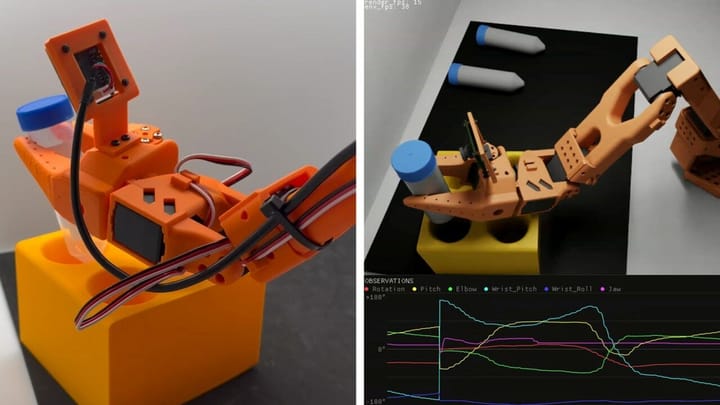
Nvidia and Hugging Face open-source robotics models to expand physical AI
Nvidia and Hugging Face are jointly developing open-source robotics models, a strategic move that lowers barriers to entry for physical AI deployment while reinforcing Nvidia's dominance in the robotics infrastructure stack. The collaboration signals a shift toward democratizing robot learning, potentially accelerating adoption across research labs and enterprises that lack proprietary model development capacity. For the broader ecosystem, this represents a critical juncture: open robotics foundations could fragment the market or establish de facto standards, depending on adoption velocity and competing initiatives from other hardware vendors.66
