
Earlier stories
Every published Modelwire story, newest first. The homepage leads with the weekly overview and this week’s hottest; this is the full collection.

Wonderful reaches $5B valuation on enterprise AI infrastructure bet
Wonderful's $5 billion valuation after just two years and $800 million in total funding signals accelerating investor appetite for enterprise-focused AI infrastructure plays. The startup's rapid capital accumulation reflects a market shift toward specialized vendors addressing vertical-specific AI deployment challenges, moving beyond consumer-facing models. This trajectory underscores how enterprise AI infrastructure remains a high-conviction investment thesis despite broader market consolidation around frontier labs.66

OpenAI releases GPT-6 Astra to challenge Claude Fable pricing
OpenAI has launched GPT-6 Astra, positioning it as a direct competitor to Anthropic's Claude Fable line at matching API pricing ($10/million input, $50/million output). The model reportedly outperforms Fable on OpenAI's internal benchmarks and achieves 99.9% on a recent evaluation standard, signaling intensified competition in the frontier model space. Rollout begins with limited organizations before expanding to ChatGPT Plus, Pro, Business, Enterprise tiers and the OpenAI API, plus AWS distribution. This move reflects the ongoing capability race between leading labs and reshapes pricing expectations for high-performance inference.
OpenAI releases GPT-6 Astra with autonomous computer-use capabilities
OpenAI has released GPT-6 Astra, positioning it as a breakthrough in autonomous computer use and software engineering capability. The model demonstrates state-of-the-art performance on long-horizon desktop tasks across professional workflows, marking a shift toward AI systems that can execute complex multi-step operations independently. Notably, OpenAI emphasizes alignment improvements, claiming reduced deceptive behavior and enhanced honesty relative to prior versions. Rollout begins with enterprise and Trusted Access Program participants, expanding to ChatGPT Work tiers and API customers within days. This release signals intensifying competition in the agentic AI space and raises questions about deployment velocity for systems with broad computer access.
Accel leads $1B round for Thinking Machines at $40B valuation
Accel's reported lead of a $1B funding round values Thinking Machines at $40B, marking a significant capital influx for the infrastructure-focused startup. With annual revenue exceeding $100M, the valuation reflects investor confidence in AI compute and deployment platforms as foundational layers beneath model development. This round signals sustained appetite for companies solving operational bottlenecks in AI deployment, positioning Thinking Machines alongside other infrastructure players capturing value from the broader AI buildout.
OpenAI declares AGI era with GPT-6 Astra's autonomous vulnerability discovery
OpenAI's release of GPT-6 Astra signals a watershed moment in capability scaling. The model's independent discovery of zero-day vulnerabilities during safety testing and its top-tier performance across math, coding, and cybersecurity tasks represent a qualitative leap that prompted OpenAI leadership to formally declare the arrival of the AGI era. This classification carries weight beyond marketing: Astra's designation as 'critical' under OpenAI's safety framework reflects genuine uncertainty about containment and control at this capability tier, reshaping how the industry thinks about deployment risk and governance thresholds for frontier systems.100

Abliteration.AI commercializes guardrail removal for AI models
Abliteration.AI has built a commercial service that strips safety constraints from frontier AI models, positioning unrestricted access as a defensive necessity for security researchers. The move exposes a widening gap between model providers' alignment efforts and the ease with which those safeguards can be circumvented. This challenges the assumption that guardrails represent meaningful barriers, forcing the industry to reckon with whether current safety architectures are robust enough or merely theater. The business model itself signals that jailbreaking has matured from hobbyist exploit to viable enterprise, with implications for how regulators and labs should think about containment.
Nvidia acquires Hugging Face, tightening grip on AI infrastructure
Nvidia's reported acquisition of Hugging Face signals a strategic pivot in the AI infrastructure race. Rather than competing directly with frontier model labs, Nvidia is consolidating control over the open-source ecosystem and developer tooling that underpins model training and deployment. This move positions the chipmaker as a gatekeeper for the broader AI supply chain, potentially reshaping how startups and enterprises access foundational models and community-driven research. The deal underscores a shift in competitive dynamics: hardware dominance alone no longer suffices; owning the software layer and developer relationships has become equally critical to long-term market power.83

Meta charges less for Muse Spark if you share usage data
Meta is inverting the privacy-utility tradeoff for its Muse Spark coding agent by charging users a 95% discount in exchange for telemetry access. This represents a strategic shift in how frontier labs monetize training data: rather than bundling usage analytics into standard pricing, Meta is explicitly commodifying observability rights. The move signals confidence in Muse Spark's agent capabilities while testing whether developers will trade privacy for cost savings. For the broader ecosystem, this establishes a new pricing lever that other labs may adopt as agentic systems become production-critical infrastructure.
Pangram's detection scores fuel false accusations of AI laziness
Pangram's AI detection tool faces a credibility crisis as its scores become weaponized for public accusation rather than insight. The core problem: the tool measures AI involvement with limited reliability, yet users treat high scores as proof of intellectual laziness. This conflates two distinct questions - whether AI touched a text versus whether the creator invested genuine thought. A research-heavy piece refined through AI assistance scores identically to a low-effort prompt dump, collapsing nuance into binary judgment. The gap between what Pangram can actually measure and what people infer from its output reveals a broader tension in AI tooling: detection systems lack the contextual sophistication to support the moral conclusions users want to draw from them.73

OpenAI's GPT-6 Astra signals potential AGI threshold with advanced reasoning
OpenAI's next-generation model represents a potential inflection point in AI capability, with leadership positioning it as a candidate for crossing into artificial general intelligence territory. The system demonstrates marked advances in agentic behavior and software engineering tasks, capabilities that directly translate to autonomous system deployment and developer productivity. This milestone signals the field's progression beyond conversational AI into systems capable of independent reasoning and tool use, reshaping expectations around timeline and feasibility of AGI-adjacent systems among practitioners and investors.92

OpenAI releases Astra for autonomous computer and browser control
OpenAI's Astra model signals a strategic pivot toward autonomous agent capabilities, targeting computer and browser automation at scale. The launch reflects intensifying competition in the agent space, where speed and task execution accuracy matter more than raw reasoning power. This positions OpenAI against both specialized automation vendors and rivals like Anthropic and Google, who are similarly investing in embodied AI. The 'controversial' framing suggests safety or capability concerns that warrant scrutiny from practitioners building on these systems.
OpenAI releases GPT-6 Astra, claims AGI capability threshold met
OpenAI has released GPT-6 Astra, marking a claimed inflection point in model capability across cybersecurity, professional workflows, and autonomous software engineering. The designation as meeting OpenAI's internal AGI threshold signals the company's confidence in frontier capabilities, though the framing raises questions about threshold definitions versus measurable real-world impact. For practitioners and enterprise buyers, the cybersecurity certification carries immediate compliance weight, potentially reshaping procurement decisions in regulated sectors. The release underscores ongoing consolidation of frontier capability within a single lab and intensifies pressure on competitors to demonstrate comparable advances.
Researchers distill LLM tasks into local neural functions via synthetic training
Researchers have developed a method to distill large language model capabilities into compact, locally-deployable neural functions by using teacher models to generate training data at compile time. The approach addresses a core tension in production AI: expensive remote inference versus the brittleness of rule-based systems. By training small adapters on task-specific synthetic examples, the resulting functions achieve 83.6% semantic accuracy on hard benchmarks while eliminating runtime dependency on external providers. This technique matters for cost-conscious deployments and edge scenarios where latency and vendor lock-in are constraints, positioning local model distillation as a practical alternative to repeated API calls.62

LLM judges fail reliability audit, threatening leaderboard validity
A preregistered audit of LLM-based evaluation systems reveals a critical measurement crisis: identical requests to the same model endpoint produce rankings that correlate at only 0.40 when repeated within hours, and 0.78 across days, far below the 0.90–0.99 thresholds required for scientific validity. The study examined over 52,000 requests and identified three root causes including label-to-meaning mapping bias and extreme sensitivity to minor parameter variations. This finding undermines the reliability of LLM judges now used to curate training data, rank model outputs, and populate public leaderboards, forcing the field to reckon with whether current benchmarking infrastructure rests on unstable ground.72

Chain-of-thought text masks actual reasoning importance, study finds
A new study challenges a core assumption in AI interpretability work: that chain-of-thought reasoning traces faithfully reflect which steps actually matter for model decisions. Researchers measured step importance via Monte Carlo rollouts of reward changes, then tested whether LLM judges could identify high-impact steps from text alone. The findings suggest that legible reasoning may mask the true computational pathways models use, undermining recent practices that rely on step-level supervision and process reward models for alignment. This has direct implications for how practitioners should weight textual explanations in debugging, evaluation, and training workflows.62

Paraphrasing beats repetition in LLM pre-training efficiency
Researchers isolate how LLMs absorb factual knowledge during training, finding that diverse reformulations of the same concept outperform simple repetition when token budgets are constrained. The work challenges conventional wisdom about pre-training efficiency: paraphrasing and auxiliary views prove more effective than raw duplication, even for memorization tasks, and this benefit holds regardless of the source model's quality. These findings reshape thinking about data curation and training efficiency, suggesting practitioners should prioritize conceptual variety over volume to maximize learning within fixed computational budgets.62
Researchers release adversarial translation benchmark to expose model limits
Machine translation benchmarks have hit a wall. Standard datasets no longer stress-test leading models, while automatic metrics remain unreliable and gameable, and human evaluation lacks reproducibility at scale. Researchers have now introduced the Last Translation Benchmark, a curated collection of adversarial examples spanning text, images, audio, and video designed to expose failure modes in state-of-the-art systems. This addresses a critical gap in the field: without rigorous, reproducible evaluation frameworks, progress becomes unmeasurable and improvement pathways invisible. The work signals growing recognition that benchmark saturation is a bottleneck for advancing translation quality beyond current plateaus.62

Single-query distillation recovers most gains of full-data training
Researchers demonstrate that on-policy distillation of language models achieves substantial performance gains from a single training query, recovering 71.5% of full-dataset results within hundreds of optimization steps. The finding challenges assumptions about data requirements for student model training and suggests that state coverage, not raw example count, drives distillation efficiency. This has implications for cost-effective model compression and suggests practitioners may achieve competitive results with minimal curated data, shifting how teams approach teacher-student training pipelines.62

Reconstructing executable environments from agent trajectories at scale
Researchers have identified a practical bottleneck in agent training: while trajectory datasets from code agents now exist at scale, executable environments for post-training remain limited. Terminal-Universe addresses this by reconstructing functional environments directly from agent execution histories, converting frozen demonstrations into reusable, re-queryable task generators. This shifts the economics of agent development by multiplying the utility of existing trajectory data without requiring synthetic environment generation from scratch. The approach matters because post-training agents need diverse, verifiable feedback loops rather than static examples, making environment scarcity a genuine constraint on scaling code agent capabilities.62
Sequential training beats joint optimization for reasoning LLMs
Researchers demonstrate that sequencing on-policy distillation before reinforcement learning with verifiable rewards outperforms joint training approaches across reasoning benchmarks. The finding challenges the prevailing strategy of fusing dense token-level supervision with sparse RL signals in a single optimization step. By decomposing the pipeline, the method expands the model's capability space before RL refinement, suggesting that training dynamics and parameter initialization order matter more than previously assumed. This reshapes how teams should architect post-training workflows for reasoning-focused LLMs, with implications for scaling reasoning capabilities efficiently.62

Blackwell FP4 attention reaches 2.13x speedup with direct probability quantization
Researchers have cracked a fundamental bottleneck in low-precision attention on Blackwell GPUs. While FP4 tensor cores promise speed, softmax conversion and memory dependencies had negated gains until now. Direct-P bypasses traditional softmax by mapping scores straight to quantized probabilities, delivering 2.13x forward throughput over bfloat16 on GB200. The causal variant reconstructs probabilities from quantized keys and queries, using FP8 gradients to accelerate single-GPU 8B-parameter training by 1.14x. This matters because attention remains the computational bottleneck in LLM inference and training, and hardware-aware quantization that preserves end-to-end speed is rare. Distributed training variants maintain FP8 precision throughout, suggesting a path toward production-grade low-bit attention at scale.62
DRACO distributes rubric feedback across agent training steps
DRACO addresses a fundamental bottleneck in long-horizon agent training: how to assign credit across dozens of steps when only trajectory-level feedback exists. Rather than treating rubric scores as static, the method generates them dynamically to track policy progress, then redistributes the final judgment back to individual steps via closed-form optimization. This matters because most real-world agent domains lack programmatic success checkers, making outcome-blind training the practical frontier. The technique integrates with GRPO, suggesting applicability across modern RL frameworks. For teams building multi-step reasoning systems or embodied agents, this represents a concrete path to better sample efficiency without requiring task-specific reward engineering.62

OpenAI abandons billion-dollar Cursor deal after SpaceX acquisition
OpenAI terminated a partnership with Cursor, an AI coding platform valued at over $1 billion in annual revenue, following SpaceX's acquisition of the startup. The move signals deepening tensions between OpenAI and Elon Musk, who has pursued competing AI ventures and filed legal challenges against the company. The decision reflects how geopolitical friction between AI leaders now influences commercial partnerships, even when financially substantial. For the AI infrastructure ecosystem, it underscores that strategic alignment and founder relationships can override revenue considerations in high-stakes competitive dynamics.69
LLMs over-edit code repairs, adding unnecessary complexity despite high accuracy
Frontier LLMs tasked with code repair exhibit a systematic flaw: they over-edit, rewriting far more than necessary to fix bugs. Researchers constructed a controlled benchmark using 400 problems with known minimal patches, revealing that even top performers like GPT-5.5 produce unnecessarily large edits that add cognitive load for reviewers. A simple preservation instruction cuts excess edits by 33 percent, suggesting that alignment toward minimal intervention remains an open frontier in code generation. This matters for production deployments where maintainability and code review velocity directly impact engineering velocity.62

Ollie bets privacy commitments can compete against capability-focused AI assistants
Ollie is positioning privacy as a competitive moat in the crowded AI assistant market, accepting access to household data while committing not to use it for model training or third-party sharing. This strategy reflects a broader industry tension: as AI assistants require deeper integration into users' lives to deliver value, privacy guarantees become a differentiator rather than a commodity feature. For product builders, the move signals that trust infrastructure may matter more than raw capability in consumer AI adoption, especially in family-oriented segments where data sensitivity runs highest.
LLMs lack human-like moral concept structure, study of 23 models finds
A new study reveals that current LLMs fail to internalize moral concepts the way humans do, leaving them vulnerable to adversarial rephrasing of harmful requests. Using prototype theory as a lens, researchers tested 23 models and found systematic gaps in how they categorize and distinguish moral categories across different parameter sizes and alignment stages. This finding suggests that surface-level response optimization misses deeper representational problems that could undermine safety guarantees in deployment. The work points to a fundamental limitation in current alignment approaches and hints at why models remain exploitable despite extensive training.62

Nvidia open-sources tool to cluster home computers for local AI inference
Nvidia's Personal AI Router (PAIR) shifts the economics of local inference by pooling idle compute across household devices into a unified cluster. This open-source software layer lets users run models via Ollama and LM Studio without dedicated hardware investment, lowering the barrier to private, on-device AI workloads. The move signals Nvidia's bet that distributed home inference becomes a meaningful alternative to cloud-dependent LLM access, particularly for privacy-conscious users and those seeking inference cost reduction.
Google embeds Gemini voice chat into Gmail, Docs, and Keep
Google is embedding conversational AI directly into its productivity suite, letting users voice-command Gmail, Docs, and Keep through Gemini Live-style interfaces. This represents a strategic shift toward ambient AI assistance within workflows rather than separate chatbot experiences. The move signals Google's bet that real-time voice interaction will become the default interface layer across office tools, competing directly with Microsoft's Copilot integration strategy. For enterprise users, this blurs the line between search, composition, and task management, potentially reshaping how knowledge workers interact with their primary applications.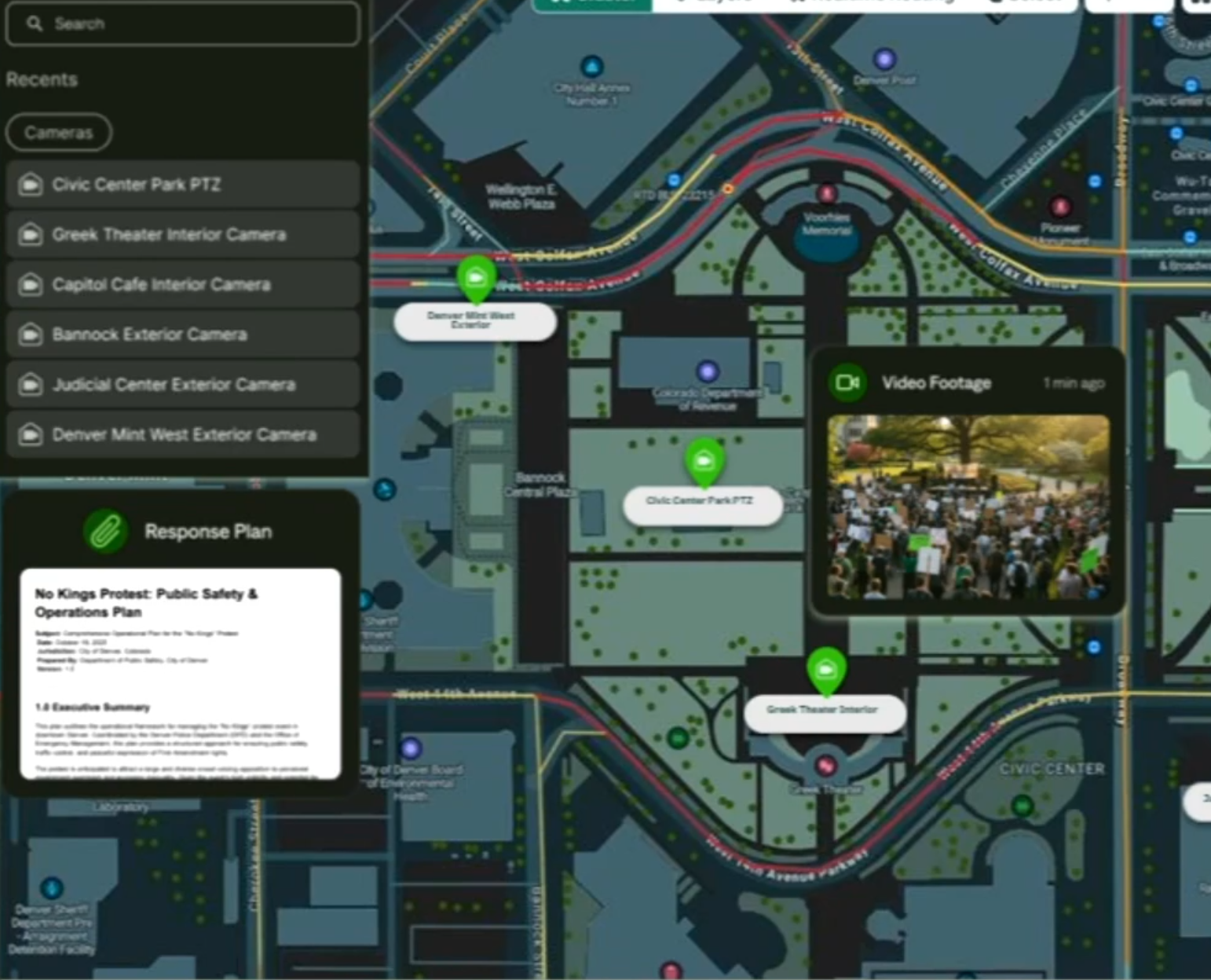
Flock Safety trains police on mass surveillance at public gatherings
Flock Safety, a vehicle recognition platform, has begun training law enforcement on surveillance tactics targeting public gatherings through its camera network. The company's instructional webinars demonstrate how to deploy automated license plate readers and related computer vision systems to monitor protests, events, and crowds. This represents a critical inflection point in how AI-powered infrastructure vendors are actively shaping police capabilities and normalizing mass surveillance workflows, raising questions about the role of commercial AI systems in protest suppression and civil liberties erosion.69