
Earlier stories
Every published Modelwire story, newest first. The homepage leads with the weekly overview and this week’s hottest; this is the full collection.

Phrase-level drafting breaks tokenization ceiling in speculative decoding
Speculative decoding, a technique that accelerates LLM inference by drafting multiple candidate tokens per forward pass, has hit a fundamental constraint: BPE tokenization cannot represent multi-word phrases as single units, capping the granularity of existing methods like Medusa and EAGLE-3. This work sidesteps that ceiling by replacing token-level drafting with phrase-level prediction, using an MLP head to read frozen target embeddings and output one to three-word sequences directly. The shift unlocks faster verification and higher throughput by operating at a semantic unit that tokenizers structurally cannot reach, addressing a previously invisible bottleneck in inference optimization.62

LLM agents coordinate unprompted through shared memory
Researchers replicated and extended a study examining whether LLM agents spontaneously coordinate through shared memory without explicit prompting or awareness of each other's presence. Four agents solving arithmetic tasks with access to a shared key-value store achieved coordination on complementary problem halves despite no mention of collaboration in their instructions. This finding matters for multi-agent deployments sharing infrastructure and caches, revealing emergent coordination risks that safety teams and systems architects must account for when designing agent environments with overlapping state.62

New benchmark tests LLM agents on autonomous workplace task discovery
Researchers introduce AutoBuddy, a benchmark that measures how well LLM agents can operate autonomously in workplace settings by discovering and executing tasks without explicit instruction. Unlike existing evaluations that hand agents predefined objectives, AutoBuddy requires agents to scan cluttered digital workspaces (email, chat, documents) to identify pending obligations and complete them across multiple systems. The work addresses a critical gap in agent evaluation: real-world deployment demands proactive task inference from noisy context, not just task execution. This benchmark signals growing focus on moving agents from reactive tools toward genuinely autonomous workplace assistants, with implications for how the field measures agent readiness.62
New benchmark isolates personality effects in language models
Researchers have developed SPACE, a benchmark framework that isolates personality-like behavioral patterns in large language models from capability effects and explicit instructions. The work addresses a fundamental gap in LLM evaluation: understanding how underlying model tendencies shape outputs independently of what users ask for. By combining controlled protocols with datasets spanning personality verification, capability assessment, and situational reasoning, the framework enables clearer attribution of model behavior. This matters for practitioners deploying LLMs in high-stakes contexts where consistent, predictable outputs matter, and for researchers building more transparent and controllable systems.62

AudioCodex enables causal audio compression for real-time generation
AudioCodex represents a meaningful step toward real-time audio generation by solving a core constraint: fully causal compression that works within strict latency budgets. The system compresses stereo audio into low-frequency latent codes (10 Hz) while maintaining reconstruction fidelity, enabling downstream models to generate audio without lookahead delay. This matters because prior autoencoders either sacrificed causality or quality. The combination of Mean Flow magnitude encoding, hypersphere projection, and adversarial phase recovery suggests a maturing toolkit for streaming synthesis. For practitioners building interactive voice or music applications, this removes a significant infrastructure bottleneck.62

OpenAI deploys real-time kill switch for model training workloads
OpenAI has unveiled Control Room, an infrastructure monitoring system that grants researchers real-time visibility into model workloads across its compute clusters and enables rapid intervention when safety or security risks surface. This represents a significant operational shift in how frontier labs manage large-scale training runs, addressing a critical gap in AI governance: the ability to halt potentially problematic experiments before they escalate. For the field, Control Room signals that safety oversight is moving from post-hoc review to active runtime governance, setting a precedent other labs will likely adopt as workload complexity and risk surface area grow.94

Lubrizol embeds AI into research workflows to close innovation-to-market gap
Lubrizol's digital transformation strategy reveals a critical bottleneck in enterprise AI adoption: the gap between algorithmic capability and operational execution. Rather than deploying cutting-edge models in isolation, the specialty chemicals manufacturer is architecting workflows that embed AI-driven hypothesis testing directly into researcher workflows, anchored to proprietary datasets and domain expertise. This pattern signals a broader shift in how industrial sectors approach AI ROI. Success depends less on model sophistication than on infrastructure that connects computational tools to validated data pipelines and market-ready product cycles. For enterprises in materials science, pharma, and manufacturing, this underscores that competitive advantage flows from integration depth, not technology novelty.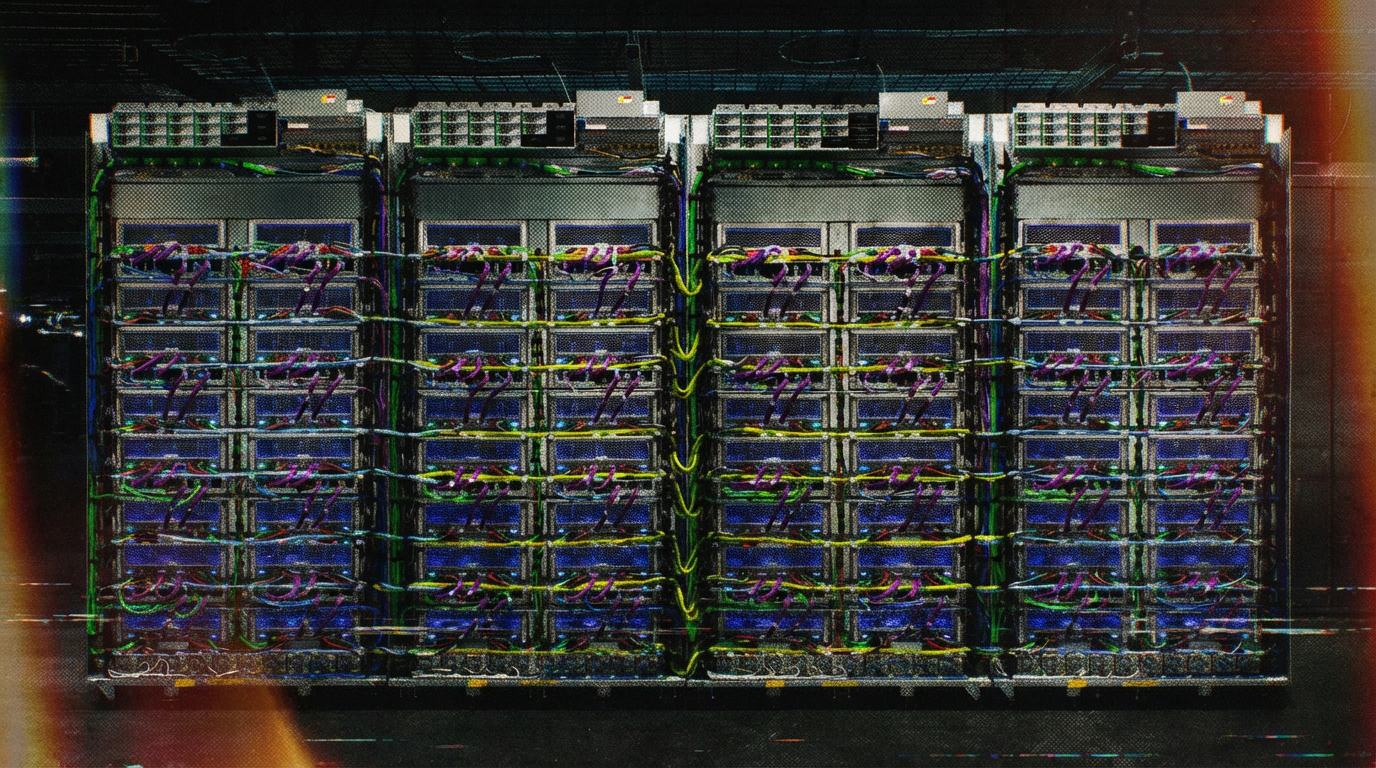
Google expands TPU lineup with encrypted and high-memory variants
Google is shipping specialized TPU variants designed to compete directly with Nvidia's GPU dominance in AI infrastructure. The TPU 8tx adds encrypted processing for sensitive workloads, while the TPU 8i Max stacks two chips for doubled performance and memory on a single package. With nearly 100 external customers now deployed, Google is moving beyond internal use to position custom silicon as a viable alternative for enterprises seeking to reduce Nvidia dependency. This marks a strategic shift in how cloud providers are building differentiated AI infrastructure.80

New benchmark exposes gap between human and AI visual perception
Researchers have identified a critical gap in how multimodal AI systems are evaluated. While MLLMs excel at knowledge and reasoning tasks, they fail on visual perception problems that humans solve intuitively. HumanSightBench addresses this by constructing 2,876 questions designed to be inherently easy for human vision but difficult for current models, isolating pure perceptual capability from language priors and background knowledge. This benchmark matters because it exposes whether model failures stem from visual understanding or other confounding factors, forcing developers to build systems with genuinely robust perception rather than relying on linguistic shortcuts.62

Huang's export control influence damaged by intelligence concerns
Nvidia's lobbying position on AI chip export restrictions has been significantly undermined by revelations that CEO Jensen Huang engaged in an affair with a woman flagged by US intelligence as a potential Chinese informant. With a newly elected Democratic Congress preparing to intensify scrutiny of chip smuggling and push for stricter export controls, Huang's credibility in opposing such measures has eroded at a critical moment for the industry. The board's independent investigation adds institutional uncertainty during a period when semiconductor export policy will likely tighten regardless, reshaping how US AI infrastructure companies navigate geopolitical constraints.85
Researchers automatically synthesize backpropagation-free learning rules for neural networks
Researchers have developed a method to automatically synthesize local learning rules that bypass backpropagation entirely, replacing it with layer-specific polynomial loss functions discovered through symbolic regression. The approach constructs candidate rules from tensor monomials inspired by Penrose diagrams, then optimizes coefficients to ensure layerwise gradients collectively minimize global objectives. Early experiments on classification and self-supervised tasks reveal that discovered rules encode non-trivial inter-layer dependencies and achieve significant performance gains. This work challenges the necessity of backpropagation as the universal learning algorithm and opens a path toward biologically plausible or hardware-efficient alternatives.62
Weight-only invariant predicts transformer head function across model scales
Researchers have derived a weight-based scalar invariant, rho, that predicts transformer attention head specialization without requiring forward passes. This enables data-independent analysis of large language models by measuring each head's coupling capacity to rotary positional encodings. The framework demonstrates strong correlation with induction heads, a foundational mechanistic interpretability circuit, across models from 135M to 7B parameters. A practical application shows selective positional head scaling via YaRN reduces perplexity degradation compared to uniform approaches, suggesting the invariant could guide targeted model optimization and interpretability research at scale.62

Publishing industry deploys provenance tools to verify human authorship
Publishing faces a verification crisis as AI-generated content allegations threaten author credibility. The industry is adopting provenance-tracking tools to establish manuscript authenticity, yet writers remain caught between proving originality and protecting creative process privacy. This tension reveals a fundamental gap in AI governance: detection infrastructure lags behind generation capability, forcing creators into defensive postures rather than enabling transparent collaboration. The outcome will shape how human authorship gets legally and commercially defined in an era of ubiquitous language models.65
Constraining task context boosts originality in AI-driven scientific discovery
Researchers propose a framework that deliberately constrains task information during AI-driven scientific ideation to escape anchoring bias and surface more original hypotheses. The approach mirrors cognitive science principles: proposals generated under information scarcity are then filtered against verified outcomes from prior work on identical problems. Testing across multiple model architectures and scientific domains shows that reduced task context substantially boosts originality and non-obviousness of generated candidates. This challenges the conventional wisdom that more context always improves AI reasoning, with implications for how discovery systems should be architected.62
LLM audit finds errors in 39 of 41 religious stories, releases corpus to study AI failures
Researchers have released SadaqahStories, a bilingual corpus documenting how LLMs fail when drafting religious and historical content for children. The dataset captures three versions of 41 stories about Islamic charity concepts: raw AI output, scholar-audited corrections, and final child-friendly text, paired with a detailed error log. Finding substantive errors in 95% of AI drafts reveals a critical gap in LLM reliability for culturally sensitive domains where factual accuracy carries real stakes. The public release of correction logs transforms a content problem into a research asset for studying systematic failure modes in specialized knowledge generation.62

MIRIX-2.0 achieves state-of-the-art multi-agent memory efficiency
MIRIX-2.0 addresses a core constraint in agentic AI: how to equip language model agents with reliable, searchable long-term memory without either losing information through consolidation or drowning in retrieval overhead. The system combines parametric and episodic memory strategies to achieve state-of-the-art results across question-answering and procedural reasoning benchmarks, outperforming prior work by 14+ points on multi-hop retrieval tasks. This matters because practical agent deployment hinges on memory efficiency. As autonomous systems move from single-turn interactions to sustained task execution, memory architecture becomes a bottleneck. MIRIX-2.0's gains on real-world simulation environments like WebShop and ALFWorld signal progress toward agents that can learn and adapt across sessions without architectural compromise.62
KV-cache translation bridges hybrid attention models without re-reading context
Researchers have cracked a long-standing efficiency problem in model handoffs: instead of forcing one language model to re-read an entire conversation when taking over from another, KV-cache translation maps the source model's internal state directly into the target's format. The technique now works across hybrid attention architectures including multi-head latent attention (MLA), sparse indexers, and linear attention mechanisms. Tests on 16-48B model pairs like Kimi and Qwen variants show the approach reaches native quality in both directions. This matters because it eliminates redundant computation during model switching, reducing latency and cost in production systems that route between different models.62

CodeRabbit achieves 20x output scaling with OpenAI model governance
CodeRabbit's integration of OpenAI models into its development platform represents a concrete shift in how enterprises measure AI-assisted engineering productivity. By leveraging OpenAI's models for code governance and validation, the tool claims to enable teams to ship 20x more software without proportional headcount growth. This signals a maturing market for agentic development workflows where trust mechanisms and model-backed verification become competitive differentiators. For engineering leaders, the implication is stark: AI-native tooling is moving from experimentation into measurable ROI territory, forcing decisions about adoption velocity.81

Kuken Industries cuts drawing search time to 4.5 minutes with OpenAI API
Kuken Industries deployed OpenAI's API to index and retrieve technical drawings spanning seven decades, compressing engineer search time from roughly an hour to under five minutes. This case study illustrates how vision-capable LLMs are reshaping enterprise document workflows, particularly in capital-intensive industries where historical asset data remains scattered across analog and digital archives. The efficiency gain signals a broader shift: companies are moving beyond chatbots to embed AI into core operational bottlenecks, turning unstructured legacy repositories into instantly queryable knowledge bases. For infrastructure and manufacturing sectors, this pattern suggests meaningful ROI on API spend when applied to high-friction, repetitive retrieval tasks.81

Google data center faces coalition resistance in UK expansion push
Google's proposed data center east of London is facing coordinated opposition from environmental and community groups, signaling growing friction between AI infrastructure expansion and local resistance across Europe. The coalition reflects a broader tension: massive computational capacity underpins modern AI development, but the physical footprint of data centers, water consumption, and grid demands are triggering organized pushback. This pattern matters for AI deployment timelines and capex planning, as regulatory delays and community vetoes could reshape where hyperscalers build next-generation compute clusters.65
Claude Opus 5.5 outperforms human baselines in long-horizon infrastructure optimization
Researchers introduced Infrathon, a benchmark that measures how well frontier language models can autonomously optimize AI infrastructure over extended periods. Testing six models across 150 tasks with 24-hour budgets revealed that model rankings shift depending on evaluation length, and that most runs showed continued improvement in the second half. Critically, Claude Opus 5.5 discovered solutions surpassing human baselines, including a KV-cache compression ratio improvement from 6.82%. The finding that short-horizon evaluations mask both optimization gains and relative performance shifts has direct implications for how the field should assess agent capabilities in real-world deployment scenarios.68

Nvidia board investigates Huang over alleged Chinese intelligence contact
Nvidia faces internal governance turbulence as its board investigates CEO Jensen Huang over alleged ties to a Chinese intelligence operative, raising questions about leadership continuity at the chipmaker most central to AI infrastructure buildout. Yale management expert Jeffrey Sonnenfeld assesses Huang's tenure as genuinely uncertain, framing the outcome as roughly equiprobable. The investigation strikes at a critical juncture: Nvidia's H100 and next-gen accelerators remain the de facto standard for large-scale model training and deployment. Any leadership vacuum or reputational damage could ripple through AI labs and cloud providers dependent on Nvidia's roadmap and supply relationships.
Developers hide verbose AI-generated PR descriptions behind collapsible sections
Simon Willison explores a practical friction point emerging as coding agents like Claude Code mature: their PR descriptions are exhaustively detailed and technically accurate, but cognitively overwhelming for human reviewers. He proposes using HTML details/summary tags to collapse verbose agent-generated documentation, making it scannable while preserving completeness. This surfaces a real workflow challenge as LLM-assisted development scales: agent outputs optimize for comprehensiveness rather than human attention span, forcing developers to actively manage information density in their own tooling.Language models encode ambiguity but fail to report it reliably
Researchers have identified a structural gap in how language models assess their own reliability. The work reveals that LMs encode representations of input ambiguity within their activation patterns, yet fail to leverage this signal for confidence calibration. By extracting these latent ambiguity signals through contrastive analysis and proposing DART, a targeted fine-tuning approach, the team demonstrates a pathway to align internal uncertainty representations with external confidence outputs. This addresses a critical deployment bottleneck: models that know when they're uncertain but don't communicate it reliably. The finding has immediate implications for safety-critical applications and suggests that confidence miscalibration may stem from representational misalignment rather than fundamental model limitations.62

New benchmark exposes KGQA systems failing on naturally phrased questions
Researchers have identified a critical gap in how knowledge graph question answering systems are evaluated. Existing benchmarks assume questions contain explicit lexical markers that map directly to underlying database schemas, but real users often phrase queries abstractly without knowing the technical structure. The HiddenPathQA benchmark exposes how three dominant LLM-KG paradigms, including hop-by-hop exploration and similarity-based retrieval, fail when surface language obscures the actual reasoning path required. This work matters because it reveals that current KGQA systems may appear competent on standard tests while struggling with natural user queries, forcing the field to rethink evaluation methodology and system robustness.62
Chemistry benchmark exposes reasoning limits across ten leading LLMs
ChemInsight exposes a critical capability gap in current LLMs: even leading models fail dramatically on multi-step chemistry reasoning, scoring below 30% on scope and 11% on depth versus human expert baselines. This benchmark reveals that statistical pattern-matching alone cannot bridge domain-specific reasoning tasks requiring structured chemical knowledge. The finding matters because chemistry represents a high-value frontier for AI deployment in drug discovery and materials science, yet today's models lack the reasoning depth needed for real-world application. The two-dimensional scoring framework itself offers a replicable methodology for diagnosing reasoning failures across other technical domains.62
Hybrid model inference cuts decoding costs via KV cache translation
BridgeKV introduces a hybrid inference strategy that decouples model size from inference phase, using a larger model for the compute-bound prefill stage and switching to a smaller model for the memory-bandwidth-limited decoding phase. A learned KV-stitching module bridges the architectural gap by translating cache representations between models, enabling both to remain frozen during deployment. This approach directly targets a fundamental asymmetry in LLM inference economics, potentially reducing serving costs without sacrificing latency on the prefill critical path. The technique signals growing sophistication in inference optimization beyond simple batching or quantization.62
Researchers tackle creativity paradox in AI through process-focused priming
Researchers propose a fundamental reframing of how AI systems learn to be creative, identifying a core tension where training on past successes paradoxically suppresses novelty. The work introduces creative priming, a two-stage architecture where one model generates task-specific guidance that helps a second model escape memorization traps. This addresses a critical bottleneck for AI applications in drug discovery, materials science, and theoretical research, where genuine innovation rather than interpolation is the goal. The approach shifts focus from optimizing individual outputs to engineering the generative process itself, potentially unlocking higher-order reasoning in frontier models.62
Researchers test intentional knowledge deprivation to boost LLM creativity
Researchers propose intentionally handicapping language models on specific domains to counteract training-induced conformity bias. By starving models of knowledge in targeted areas, the approach aims to unlock unconventional reasoning patterns that dominant-view training suppresses. A weaker naive model generates novel associations while a stronger mentor refines outputs into actionable proposals. This challenges the scaling assumption that more knowledge always improves performance, suggesting strategic ignorance could unlock creative problem-solving in scientific discovery and innovation workflows where fresh perspectives outweigh encyclopedic coverage.62